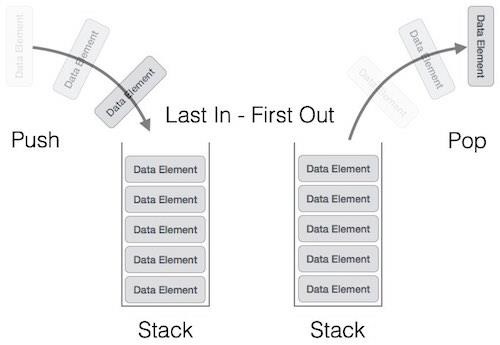
- Stacks of plates
- Trains
- Vending Machines
- Expression Evaluation
- Matching delimiters
- Navigating a maze
- Map coloring
- Many more examples
Wrapper around a built-in list object Array-based, bounded or expandable (All operations in Θ(1) except search and access)

Linked (All operations in Θ(1) except search and access)

The Java Core API has a stack class in the package java.util but you should avoid it since it subclasses Vector and thus has a bunch of non-stack operations (this is a major design flaw in the library), and it is (perhaps unnecessarily) synchronized making it slow (though always thread-safe).
Regardless, you should learn how to build a stack ADT from scratch, because:
- This is the only way for you to really learn how stacks work
- You need coding practice, especially with linked structures
- You need to know how to code things up when you find yourself in a very restrictive environment that doesn't have a collections library.
`
public interface Stack {
/**
* Adds the given item to the top of the stack.
*/
void push(Object item);
/**
* Removes the top item from the stack and returns it.
* @exception java.util.NoSuchElementException if the stack is empty.
*/
Object pop();
/**
* Returns the top item from the stack without popping it.
* @exception java.util.NoSuchElementException if the stack is empty.
*/
Object peek();
/**
* Returns the number of items currently in the stack.
*/
int size();
/**
* Returns whether the stack is empty or not.
*/
boolean isEmpty();
}
`
One way to make our own stack is to make a wrapper around the existing LinkedList class. `
public class SimpleStack implements Stack {
private LinkedList<Object> list = new LinkedList<Object>();
public void push(Object item) {list.addFirst(item);} //push()
public Object pop() {return list.removeFirst();} //pop()
public Object peek() {return list.getFirst();} //peek()
public int size() {return list.size();}
public boolean isEmpty() {return list.isEmpty();}
}
` This is a common design pattern and all developers are expected to know how to do this. Terminology associated with this technique:
- "The stack wraps the list"
- "The list is being adapted to use in a stack context"
- "The stack delegates to the list"
- "The list interface is being narrowed to that of a stack"
Things to note here:
- The capacity is set at creation time
- Pushes have a precondition that the stack isn't already full
- Pushing on a full stack is a state exception, not an argument exception
- The field for the current size doubles as the index of the next item to be pushed, and
- When popping, we take care to nullify the newly unused slot in the array to prevent a possible memory leak
`
public class BoundedStack implements Stack{
private Object[] array;
private int size = 0;
public BoundedStack(int capacity) {
array = new Object[capacity];
}
public void push(Object item) {
if (size == array.length) {
throw new IllegalStateException("Cannot add to full stack");
}
array[size++] = item;
}
public Object pop() {
if (size == 0) {
throw new NoSuchElementException("Cannot pop from empty stack");
}
Object result = array[size-1];
array[--size] = null;
return result;
}
public Object peek() {
if (size == 0) {
throw new NoSuchElementException("Cannot peek into empty stack");
}
return array[size - 1];
}
public boolean isEmpty() {
return size == 0;
}
public int size() {
return size;
}
}
`
`
/**
* An implementation of the stack interface using singly-linked
* nodes.
*/
public class LinkedStack implements Stack {
private class Node {
public Object data;
public Node next;
public Node(Object data, Node next) {
this.data = data;
this.next = next;
}
}
private Node top = null;
public void push(Object item) {
top = new Node(item, top);
}
public Object pop() {
Object item = peek();
top = top.next;
return item;
}
public boolean isEmpty() {
return top == null;
}
public Object peek() {
if (top == null) {
throw new NoSuchElementException();
}
return top.data;
}
public int size() {
int count = 0;
for (Node node = top; node != null; node = node.next) {
count++;
}
return count;
}
}
`
