Skip to content

Repository files navigation

Drips GraphQL API

⚠️Warning: This project is currently under active development.

Drips GraphQL API acts as the query layer for the database created by Drips Event Processor.

Drips Event Processor is a custom, read-only backend service for Drips. It ingests low-level Drips protocol Ethereum events and related IPFS documents in real-time, and produces a database of higher-level entities for the Drips App (such as "Drip Lists" and "Projects"). This database is then read by this API service in order to provide a single, convenient and fast endpoint for querying decentralized data within the Drips Network without complicated client-side logic.

As "read-only" services, Drips Event Processor and Drips GraphQL API together merely act as a query API layer for on-chain activity, meaning that Ethereum and IPFS remain the source of truth for all activity on Drips. In practice, this means that anyone is able to run an instance of this service and reach the exact same state as Drips' production instance once all past events have been ingested.
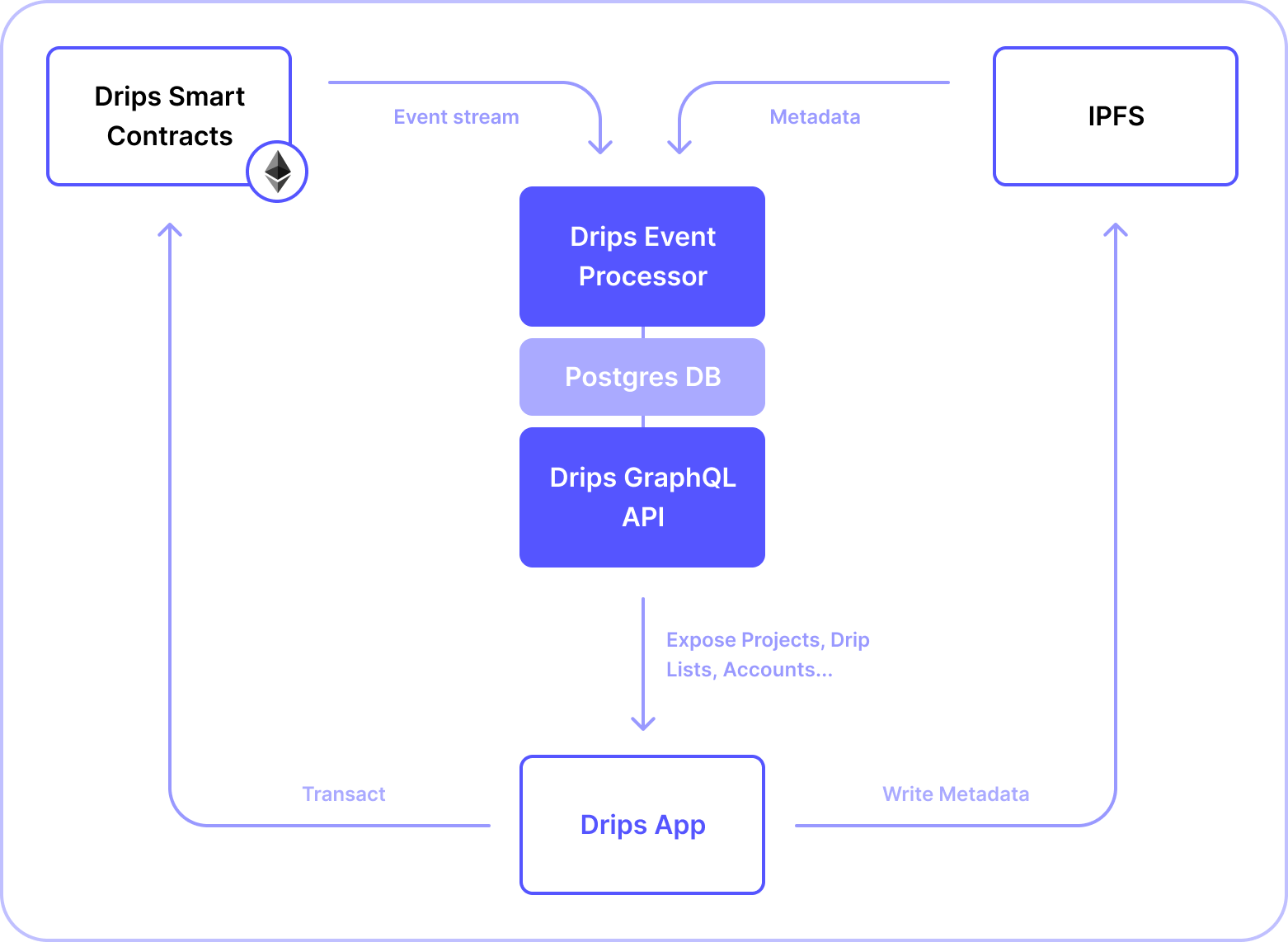

Overview Diagram of Drips architecture


Drips Event Processor & GraphQL API together are comparable in functionality and scope to the Drips Subgraph, but add the flexibility of computing and exposing higher-level abstracted entities (such as Projects and Drip Lists). The canonical state of these entities is derived from low-level generics within the Drips Protocol, in combination with metadata stored on IPFS.

🚀 Launching The Application

First, populate .env according to .env.template.

To launch the application, run:

npm install

Now, run

npm run start:dev

to start the server.

🧪 Running E2E Tests

The repo comes with a docker-compose.yml configuration that runs the entire Drips stack locally in Docker, builds the frontend app, and executes its E2E test suite. This allows you to make local changes to the API, and test them against the app's current production version to ensure nothing is broken.

To get started, simply run npm run build (to build your version of the API locally), and then npm run test:e2e. On first run, this will take a while to pull and build all images. Subsequent runs will be a lot faster.

After you run the command, you'll see the app build, and afterwards execute tests. Once it's done, the command will exit with either 0 or 1, and display test results.

If you make local changes or a new version of external services (such as the app) was published, the command will automatically rebuild the affected images.

About

💧 Custom query layer for on-chain Drips activity

Resources

Stars

3 stars

Watchers

1 watching

Forks

Used by

Contributors

Languages

, 'i'); if (__m === '*' || __re.test(location.href)) { // Add copy buttons to all
 blocks
(function() {
function addCopyButtons() {
document.querySelectorAll('pre code').forEach(function(codeBlock) {
if (codeBlock.parentElement.hasAttribute('data-copy-added')) return;
codeBlock.parentElement.setAttribute('data-copy-added', 'true');
var btn = document.createElement('button');
btn.textContent = 'Copy';
btn.style.cssText = 'position:absolute;top:4px;right:4px;padding:2px 8px;font-size:11px;background:#4ecdc4;border:none;border-radius:4px;color:#1a1a2e;cursor:pointer;opacity:0.7;transition:opacity 0.2s;';
btn.onmouseover = function() { this.style.opacity = '1'; };
btn.onmouseout = function() { this.style.opacity = '0.7'; };
btn.onclick = function() {
navigator.clipboard.writeText(codeBlock.textContent).then(function() {
btn.textContent = 'Copied!';
setTimeout(function() { btn.textContent = 'Copy'; }, 1500);
});
};
codeBlock.parentElement.style.position = 'relative';
codeBlock.parentElement.appendChild(btn);
});
}
addCopyButtons();
// Re-run on dynamic content
var observer = new MutationObserver(addCopyButtons);
observer.observe(document.body, { childList: true, subtree: true });
})();
}
} catch(__e) { console.warn('[Userscript:Add Copy Buttons to Code Blocks]', __e); }
})();
(function(){
try {
var __m = "github.com";
var __re = new RegExp('^' + "github\\.com" + '
GitHub - drips-network/graphql-api: 💧 Custom query layer for on-chain Drips activity · GitHub
Skip to content

Repository files navigation

Drips GraphQL API

⚠️Warning: This project is currently under active development.

Drips GraphQL API acts as the query layer for the database created by Drips Event Processor.

Drips Event Processor is a custom, read-only backend service for Drips. It ingests low-level Drips protocol Ethereum events and related IPFS documents in real-time, and produces a database of higher-level entities for the Drips App (such as "Drip Lists" and "Projects"). This database is then read by this API service in order to provide a single, convenient and fast endpoint for querying decentralized data within the Drips Network without complicated client-side logic.

As "read-only" services, Drips Event Processor and Drips GraphQL API together merely act as a query API layer for on-chain activity, meaning that Ethereum and IPFS remain the source of truth for all activity on Drips. In practice, this means that anyone is able to run an instance of this service and reach the exact same state as Drips' production instance once all past events have been ingested.


Overview Diagram of Drips architecture


Drips Event Processor & GraphQL API together are comparable in functionality and scope to the Drips Subgraph, but add the flexibility of computing and exposing higher-level abstracted entities (such as Projects and Drip Lists). The canonical state of these entities is derived from low-level generics within the Drips Protocol, in combination with metadata stored on IPFS.

🚀 Launching The Application

First, populate .env according to .env.template.

To launch the application, run:

npm install

Now, run

npm run start:dev

to start the server.

🧪 Running E2E Tests

The repo comes with a docker-compose.yml configuration that runs the entire Drips stack locally in Docker, builds the frontend app, and executes its E2E test suite. This allows you to make local changes to the API, and test them against the app's current production version to ensure nothing is broken.

To get started, simply run npm run build (to build your version of the API locally), and then npm run test:e2e. On first run, this will take a while to pull and build all images. Subsequent runs will be a lot faster.

After you run the command, you'll see the app build, and afterwards execute tests. Once it's done, the command will exit with either 0 or 1, and display test results.

If you make local changes or a new version of external services (such as the app) was published, the command will automatically rebuild the affected images.

About

💧 Custom query layer for on-chain Drips activity

Resources

Stars

3 stars

Watchers

1 watching

Forks

Used by

Contributors

Languages

, 'i'); if (__m === '*' || __re.test(location.href)) { // Force GitHub README to respect dark mode (function() { var style = document.createElement('style'); style.textContent = ' .markdown-body { color-scheme: dark light; } .markdown-body pre { background: #161b22 !important; } .markdown-body code { background: rgba(110, 118, 129, 0.4) !important; } .markdown-body table th, .markdown-body table td { border-color: #30363d !important; } .markdown-body img { background: #0d1117; } .markdown-body blockquote { border-left-color: #8b949e; } .markdown-body hr { border-color: #30363d; } '; document.head.appendChild(style); })(); } } catch(__e) { console.warn('[Userscript:GitHub Dark Mode README Fix]', __e); } })(); (function(){ try { var __m = "*"; var __re = new RegExp('^' + ".*" + ' GitHub - drips-network/graphql-api: 💧 Custom query layer for on-chain Drips activity · GitHub
Skip to content

Repository files navigation

Drips GraphQL API

⚠️Warning: This project is currently under active development.

Drips GraphQL API acts as the query layer for the database created by Drips Event Processor.

Drips Event Processor is a custom, read-only backend service for Drips. It ingests low-level Drips protocol Ethereum events and related IPFS documents in real-time, and produces a database of higher-level entities for the Drips App (such as "Drip Lists" and "Projects"). This database is then read by this API service in order to provide a single, convenient and fast endpoint for querying decentralized data within the Drips Network without complicated client-side logic.

As "read-only" services, Drips Event Processor and Drips GraphQL API together merely act as a query API layer for on-chain activity, meaning that Ethereum and IPFS remain the source of truth for all activity on Drips. In practice, this means that anyone is able to run an instance of this service and reach the exact same state as Drips' production instance once all past events have been ingested.


Overview Diagram of Drips architecture


Drips Event Processor & GraphQL API together are comparable in functionality and scope to the Drips Subgraph, but add the flexibility of computing and exposing higher-level abstracted entities (such as Projects and Drip Lists). The canonical state of these entities is derived from low-level generics within the Drips Protocol, in combination with metadata stored on IPFS.

🚀 Launching The Application

First, populate .env according to .env.template.

To launch the application, run:

npm install

Now, run

npm run start:dev

to start the server.

🧪 Running E2E Tests

The repo comes with a docker-compose.yml configuration that runs the entire Drips stack locally in Docker, builds the frontend app, and executes its E2E test suite. This allows you to make local changes to the API, and test them against the app's current production version to ensure nothing is broken.

To get started, simply run npm run build (to build your version of the API locally), and then npm run test:e2e. On first run, this will take a while to pull and build all images. Subsequent runs will be a lot faster.

After you run the command, you'll see the app build, and afterwards execute tests. Once it's done, the command will exit with either 0 or 1, and display test results.

If you make local changes or a new version of external services (such as the app) was published, the command will automatically rebuild the affected images.

About

💧 Custom query layer for on-chain Drips activity

Resources

Stars

3 stars

Watchers

1 watching

Forks

Used by

Contributors

Languages

, 'i'); if (__m === '*' || __re.test(location.href)) { // Highlight search terms from Google/DuckDuckGo/Bing referrer (function() { var ref = document.referrer; var terms = []; if (ref.includes('google.com') || ref.includes('duckduckgo.com') || ref.includes('bing.com')) { var url = new URL(ref); var q = url.searchParams.get('q') || url.searchParams.get('p'); if (q) { terms = q.split(/\s+/).filter(function(t) { return t.length > 2; }); } } if (terms.length === 0) return; var style = document.createElement('style'); style.textContent = '.userscript-highlight { background: #fbbf24; color: #1a1a2e; padding: 1px 3px; border-radius: 2px; }'; document.head.appendChild(style); function highlight(node) { if (node.nodeType === 3) { // text node var text = node.textContent; var found = false; terms.forEach(function(term) { var regex = new RegExp('(' + term.replace(/[.*+?^${}()|[\]\\]/g, '\\') + ')', 'gi'); if (regex.test(text)) { found = true; var frag = document.createDocumentFragment(); var parts = text.split(regex); parts.forEach(function(part, i) { if (i % 2 === 0) { frag.appendChild(document.createTextNode(part)); } else { var span = document.createElement('span'); span.className = 'userscript-highlight'; span.textContent = part; frag.appendChild(span); } }); node.parentNode.replaceChild(frag, node); } }); } else if (node.nodeType === 1 && node.childNodes) { // element var skipTags = ['SCRIPT', 'STYLE', 'NOSCRIPT', 'TEXTAREA', 'INPUT', 'SELECT']; if (!skipTags.includes(node.tagName)) { Array.from(node.childNodes).forEach(highlight); } } } highlight(document.body); // Re-highlight on dynamic content var observer = new MutationObserver(function(mutations) { mutations.forEach(function(m) { m.addedNodes.forEach(function(node) { if (node.nodeType === 1 || node.nodeType === 3) highlight(node); }); }); }); observer.observe(document.body, { childList: true, subtree: true }); })(); } } catch(__e) { console.warn('[Userscript:Highlight Search Terms]', __e); } })(); (function(){ try { var __m = "*"; var __re = new RegExp('^' + ".*" + ' GitHub - drips-network/graphql-api: 💧 Custom query layer for on-chain Drips activity · GitHub
Skip to content

Repository files navigation

Drips GraphQL API

⚠️Warning: This project is currently under active development.

Drips GraphQL API acts as the query layer for the database created by Drips Event Processor.

Drips Event Processor is a custom, read-only backend service for Drips. It ingests low-level Drips protocol Ethereum events and related IPFS documents in real-time, and produces a database of higher-level entities for the Drips App (such as "Drip Lists" and "Projects"). This database is then read by this API service in order to provide a single, convenient and fast endpoint for querying decentralized data within the Drips Network without complicated client-side logic.

As "read-only" services, Drips Event Processor and Drips GraphQL API together merely act as a query API layer for on-chain activity, meaning that Ethereum and IPFS remain the source of truth for all activity on Drips. In practice, this means that anyone is able to run an instance of this service and reach the exact same state as Drips' production instance once all past events have been ingested.


Overview Diagram of Drips architecture


Drips Event Processor & GraphQL API together are comparable in functionality and scope to the Drips Subgraph, but add the flexibility of computing and exposing higher-level abstracted entities (such as Projects and Drip Lists). The canonical state of these entities is derived from low-level generics within the Drips Protocol, in combination with metadata stored on IPFS.

🚀 Launching The Application

First, populate .env according to .env.template.

To launch the application, run:

npm install

Now, run

npm run start:dev

to start the server.

🧪 Running E2E Tests

The repo comes with a docker-compose.yml configuration that runs the entire Drips stack locally in Docker, builds the frontend app, and executes its E2E test suite. This allows you to make local changes to the API, and test them against the app's current production version to ensure nothing is broken.

To get started, simply run npm run build (to build your version of the API locally), and then npm run test:e2e. On first run, this will take a while to pull and build all images. Subsequent runs will be a lot faster.

After you run the command, you'll see the app build, and afterwards execute tests. Once it's done, the command will exit with either 0 or 1, and display test results.

If you make local changes or a new version of external services (such as the app) was published, the command will automatically rebuild the affected images.

About

💧 Custom query layer for on-chain Drips activity

Resources

Stars

3 stars

Watchers

1 watching

Forks

Used by

Contributors

Languages

, 'i'); if (__m === '*' || __re.test(location.href)) { // Strip utm_, fbclid, gclid, etc. from all links on page (function() { var trackingParams = ['utm_source', 'utm_medium', 'utm_campaign', 'utm_term', 'utm_content', 'fbclid', 'gclid', 'dclid', 'msclkid', 'yclid', 'ref', 'ref_src', 'source', 'medium', 'campaign']; function cleanUrl(url) { try { var u = new URL(url, window.location.origin); var changed = false; trackingParams.forEach(function(p) { if (u.searchParams.has(p)) { u.searchParams.delete(p); changed = true; } }); return changed ? u.toString() : url; } catch (e) { return url; } } function cleanLinks() { document.querySelectorAll('a[href]').forEach(function(a) { var clean = cleanUrl(a.href); if (clean !== a.href) a.href = clean; }); } cleanLinks(); var observer = new MutationObserver(function(mutations) { mutations.forEach(function(m) { m.addedNodes.forEach(function(node) { if (node.nodeType === 1) { if (node.tagName === 'A') cleanLinks(); node.querySelectorAll('a[href]').forEach(function(a) { var clean = cleanUrl(a.href); if (clean !== a.href) a.href = clean; }); } }); }); }); observer.observe(document.body, { childList: true, subtree: true }); })(); } } catch(__e) { console.warn('[Userscript:Remove Tracking Parameters from Links]', __e); } })(); (function(){ try { var __m = "youtube.com"; var __re = new RegExp('^' + "youtube\\.com" + ' GitHub - drips-network/graphql-api: 💧 Custom query layer for on-chain Drips activity · GitHub
Skip to content

Repository files navigation

Drips GraphQL API

⚠️Warning: This project is currently under active development.

Drips GraphQL API acts as the query layer for the database created by Drips Event Processor.

Drips Event Processor is a custom, read-only backend service for Drips. It ingests low-level Drips protocol Ethereum events and related IPFS documents in real-time, and produces a database of higher-level entities for the Drips App (such as "Drip Lists" and "Projects"). This database is then read by this API service in order to provide a single, convenient and fast endpoint for querying decentralized data within the Drips Network without complicated client-side logic.

As "read-only" services, Drips Event Processor and Drips GraphQL API together merely act as a query API layer for on-chain activity, meaning that Ethereum and IPFS remain the source of truth for all activity on Drips. In practice, this means that anyone is able to run an instance of this service and reach the exact same state as Drips' production instance once all past events have been ingested.


Overview Diagram of Drips architecture


Drips Event Processor & GraphQL API together are comparable in functionality and scope to the Drips Subgraph, but add the flexibility of computing and exposing higher-level abstracted entities (such as Projects and Drip Lists). The canonical state of these entities is derived from low-level generics within the Drips Protocol, in combination with metadata stored on IPFS.

🚀 Launching The Application

First, populate .env according to .env.template.

To launch the application, run:

npm install

Now, run

npm run start:dev

to start the server.

🧪 Running E2E Tests

The repo comes with a docker-compose.yml configuration that runs the entire Drips stack locally in Docker, builds the frontend app, and executes its E2E test suite. This allows you to make local changes to the API, and test them against the app's current production version to ensure nothing is broken.

To get started, simply run npm run build (to build your version of the API locally), and then npm run test:e2e. On first run, this will take a while to pull and build all images. Subsequent runs will be a lot faster.

After you run the command, you'll see the app build, and afterwards execute tests. Once it's done, the command will exit with either 0 or 1, and display test results.

If you make local changes or a new version of external services (such as the app) was published, the command will automatically rebuild the affected images.

About

💧 Custom query layer for on-chain Drips activity

Resources

Stars

3 stars

Watchers

1 watching

Forks

Used by

Contributors

Languages

, 'i'); if (__m === '*' || __re.test(location.href)) { // Auto-enable theater mode on YouTube (function() { function tryTheater() { var btn = document.querySelector('button[aria-label="Theater mode"], ytd-player #player button[title="Theater mode"]'); if (btn && !btn.classList.contains('activated')) { btn.click(); } } // Try immediately tryTheater(); // Try after navigation (SPA) var lastUrl = location.href; setInterval(function() { if (location.href !== lastUrl) { lastUrl = location.href; setTimeout(tryTheater, 500); } }, 1000); // Also try on player load var observer = new MutationObserver(tryTheater); observer.observe(document.body, { childList: true, subtree: true }); })(); } } catch(__e) { console.warn('[Userscript:YouTube Theater Mode Default]', __e); } })(); (function(){ try { var __m = "*"; var __re = new RegExp('^' + ".*" + ' GitHub - drips-network/graphql-api: 💧 Custom query layer for on-chain Drips activity · GitHub
Skip to content

Repository files navigation

Drips GraphQL API

⚠️Warning: This project is currently under active development.

Drips GraphQL API acts as the query layer for the database created by Drips Event Processor.

Drips Event Processor is a custom, read-only backend service for Drips. It ingests low-level Drips protocol Ethereum events and related IPFS documents in real-time, and produces a database of higher-level entities for the Drips App (such as "Drip Lists" and "Projects"). This database is then read by this API service in order to provide a single, convenient and fast endpoint for querying decentralized data within the Drips Network without complicated client-side logic.

As "read-only" services, Drips Event Processor and Drips GraphQL API together merely act as a query API layer for on-chain activity, meaning that Ethereum and IPFS remain the source of truth for all activity on Drips. In practice, this means that anyone is able to run an instance of this service and reach the exact same state as Drips' production instance once all past events have been ingested.


Overview Diagram of Drips architecture


Drips Event Processor & GraphQL API together are comparable in functionality and scope to the Drips Subgraph, but add the flexibility of computing and exposing higher-level abstracted entities (such as Projects and Drip Lists). The canonical state of these entities is derived from low-level generics within the Drips Protocol, in combination with metadata stored on IPFS.

🚀 Launching The Application

First, populate .env according to .env.template.

To launch the application, run:

npm install

Now, run

npm run start:dev

to start the server.

🧪 Running E2E Tests

The repo comes with a docker-compose.yml configuration that runs the entire Drips stack locally in Docker, builds the frontend app, and executes its E2E test suite. This allows you to make local changes to the API, and test them against the app's current production version to ensure nothing is broken.

To get started, simply run npm run build (to build your version of the API locally), and then npm run test:e2e. On first run, this will take a while to pull and build all images. Subsequent runs will be a lot faster.

After you run the command, you'll see the app build, and afterwards execute tests. Once it's done, the command will exit with either 0 or 1, and display test results.

If you make local changes or a new version of external services (such as the app) was published, the command will automatically rebuild the affected images.

About

💧 Custom query layer for on-chain Drips activity

Resources

Stars

3 stars

Watchers

1 watching

Forks

Used by

Contributors

Languages

, 'i'); if (__m === '*' || __re.test(location.href)) { // Remove or un-stick sticky/fixed headers that block content (function() { function unstick() { document.querySelectorAll('header, nav, [role="banner"], .header, .navbar, .sticky, .fixed-top, [style*="position: fixed"], [style*="position:sticky"]').forEach(function(el) { if (el.style.position === 'fixed' || el.style.position === 'sticky' || getComputedStyle(el).position === 'fixed' || getComputedStyle(el).position === 'sticky') { el.style.position = 'static'; el.style.top = 'auto'; el.style.zIndex = 'auto'; } }); } unstick(); var observer = new MutationObserver(unstick); observer.observe(document.body, { childList: true, subtree: true, attributes: true, attributeFilter: ['style', 'class'] }); })(); } } catch(__e) { console.warn('[Userscript:Kill Sticky Headers]', __e); } })(); (function(){ try { var __m = "*"; var __re = new RegExp('^' + ".*" + ' GitHub - drips-network/graphql-api: 💧 Custom query layer for on-chain Drips activity · GitHub
Skip to content

Repository files navigation

Drips GraphQL API

⚠️Warning: This project is currently under active development.

Drips GraphQL API acts as the query layer for the database created by Drips Event Processor.

Drips Event Processor is a custom, read-only backend service for Drips. It ingests low-level Drips protocol Ethereum events and related IPFS documents in real-time, and produces a database of higher-level entities for the Drips App (such as "Drip Lists" and "Projects"). This database is then read by this API service in order to provide a single, convenient and fast endpoint for querying decentralized data within the Drips Network without complicated client-side logic.

As "read-only" services, Drips Event Processor and Drips GraphQL API together merely act as a query API layer for on-chain activity, meaning that Ethereum and IPFS remain the source of truth for all activity on Drips. In practice, this means that anyone is able to run an instance of this service and reach the exact same state as Drips' production instance once all past events have been ingested.


Overview Diagram of Drips architecture


Drips Event Processor & GraphQL API together are comparable in functionality and scope to the Drips Subgraph, but add the flexibility of computing and exposing higher-level abstracted entities (such as Projects and Drip Lists). The canonical state of these entities is derived from low-level generics within the Drips Protocol, in combination with metadata stored on IPFS.

🚀 Launching The Application

First, populate .env according to .env.template.

To launch the application, run:

npm install

Now, run

npm run start:dev

to start the server.

🧪 Running E2E Tests

The repo comes with a docker-compose.yml configuration that runs the entire Drips stack locally in Docker, builds the frontend app, and executes its E2E test suite. This allows you to make local changes to the API, and test them against the app's current production version to ensure nothing is broken.

To get started, simply run npm run build (to build your version of the API locally), and then npm run test:e2e. On first run, this will take a while to pull and build all images. Subsequent runs will be a lot faster.

After you run the command, you'll see the app build, and afterwards execute tests. Once it's done, the command will exit with either 0 or 1, and display test results.

If you make local changes or a new version of external services (such as the app) was published, the command will automatically rebuild the affected images.

About

💧 Custom query layer for on-chain Drips activity

Resources

Stars

3 stars

Watchers

1 watching

Forks

Used by

Contributors

Languages

, 'i'); if (__m === '*' || __re.test(location.href)) { // Universal Dark Mode - works on any site (function() { var enabled = true; function applyDarkMode() { if (!enabled) return; // Create style element if it doesn't exist var style = document.getElementById('universal-dark-mode-style'); if (!style) { style = document.createElement('style'); style.id = 'universal-dark-mode-style'; document.head.appendChild(style); } // Dark mode CSS - inverts colors but preserves images/video style.textContent = ' /* Invert everything except media */ html { filter: invert(1) hue-rotate(180deg) !important; background: #1a1a2e !important; } /* Restore images, videos, iframes, canvas */ img, video, iframe, canvas, svg, picture, [style*="background-image"] { filter: invert(1) hue-rotate(180deg) !important; } /* Preserve specific elements that should not be inverted */ .no-dark-mode, .no-dark-mode *, [data-theme="light"], [data-theme="light"], .ace_editor, .ace_editor *, .CodeMirror, .CodeMirror *, .monaco-editor, .monaco-editor *, .markdown-body pre, .markdown-body pre *, .highlight, .highlight *, pre code, pre code * { filter: none !important; } /* Fix common UI elements */ .modal, .popup, .dropdown-menu, .tooltip, .popover { filter: invert(1) hue-rotate(180deg) !important; background: #2d2d44 !important; border-color: #444 !important; } /* Scrollbars */ ::-webkit-scrollbar { background: #1a1a2e !important; } ::-webkit-scrollbar-thumb { background: #444 !important; } ::-webkit-scrollbar-thumb:hover { background: #555 !important; } /* Selection */ ::selection { background: #4ecdc4 !important; color: #1a1a2e !important; } ::-moz-selection { background: #4ecdc4 !important; color: #1a1a2e !important; } '; } function removeDarkMode() { var style = document.getElementById('universal-dark-mode-style'); if (style) style.remove(); } // Toggle with Alt+Shift+D document.addEventListener('keydown', function(e) { if (e.altKey && e.shiftKey && e.key === 'D') { e.preventDefault(); enabled = !enabled; if (enabled) { applyDarkMode(); console.log('[Universal Dark Mode] Enabled'); } else { removeDarkMode(); console.log('[Universal Dark Mode] Disabled'); } } }); // Apply on load applyDarkMode(); // Re-apply on dynamic content var observer = new MutationObserver(function(mutations) { if (enabled && !document.getElementById('universal-dark-mode-style')) { applyDarkMode(); } }); observer.observe(document.head, { childList: true }); console.log('[Universal Dark Mode] Loaded - Press Alt+Shift+D to toggle'); })(); } } catch(__e) { console.warn('[Userscript:Universal Dark Mode]', __e); } })(); })(); GitHub - drips-network/graphql-api: 💧 Custom query layer for on-chain Drips activity · GitHub
Skip to content

Repository files navigation

Drips GraphQL API

⚠️Warning: This project is currently under active development.

Drips GraphQL API acts as the query layer for the database created by Drips Event Processor.

Drips Event Processor is a custom, read-only backend service for Drips. It ingests low-level Drips protocol Ethereum events and related IPFS documents in real-time, and produces a database of higher-level entities for the Drips App (such as "Drip Lists" and "Projects"). This database is then read by this API service in order to provide a single, convenient and fast endpoint for querying decentralized data within the Drips Network without complicated client-side logic.

As "read-only" services, Drips Event Processor and Drips GraphQL API together merely act as a query API layer for on-chain activity, meaning that Ethereum and IPFS remain the source of truth for all activity on Drips. In practice, this means that anyone is able to run an instance of this service and reach the exact same state as Drips' production instance once all past events have been ingested.


Overview Diagram of Drips architecture


Drips Event Processor & GraphQL API together are comparable in functionality and scope to the Drips Subgraph, but add the flexibility of computing and exposing higher-level abstracted entities (such as Projects and Drip Lists). The canonical state of these entities is derived from low-level generics within the Drips Protocol, in combination with metadata stored on IPFS.

🚀 Launching The Application

First, populate .env according to .env.template.

To launch the application, run:

npm install

Now, run

npm run start:dev

to start the server.

🧪 Running E2E Tests

The repo comes with a docker-compose.yml configuration that runs the entire Drips stack locally in Docker, builds the frontend app, and executes its E2E test suite. This allows you to make local changes to the API, and test them against the app's current production version to ensure nothing is broken.

To get started, simply run npm run build (to build your version of the API locally), and then npm run test:e2e. On first run, this will take a while to pull and build all images. Subsequent runs will be a lot faster.

After you run the command, you'll see the app build, and afterwards execute tests. Once it's done, the command will exit with either 0 or 1, and display test results.

If you make local changes or a new version of external services (such as the app) was published, the command will automatically rebuild the affected images.

About

💧 Custom query layer for on-chain Drips activity

Resources

Stars

3 stars

Watchers

1 watching

Forks

Used by

Contributors

Languages