
qFoldIT

LEGO brick road to open science on the cover of Trends in Biotechnology, September 2022.

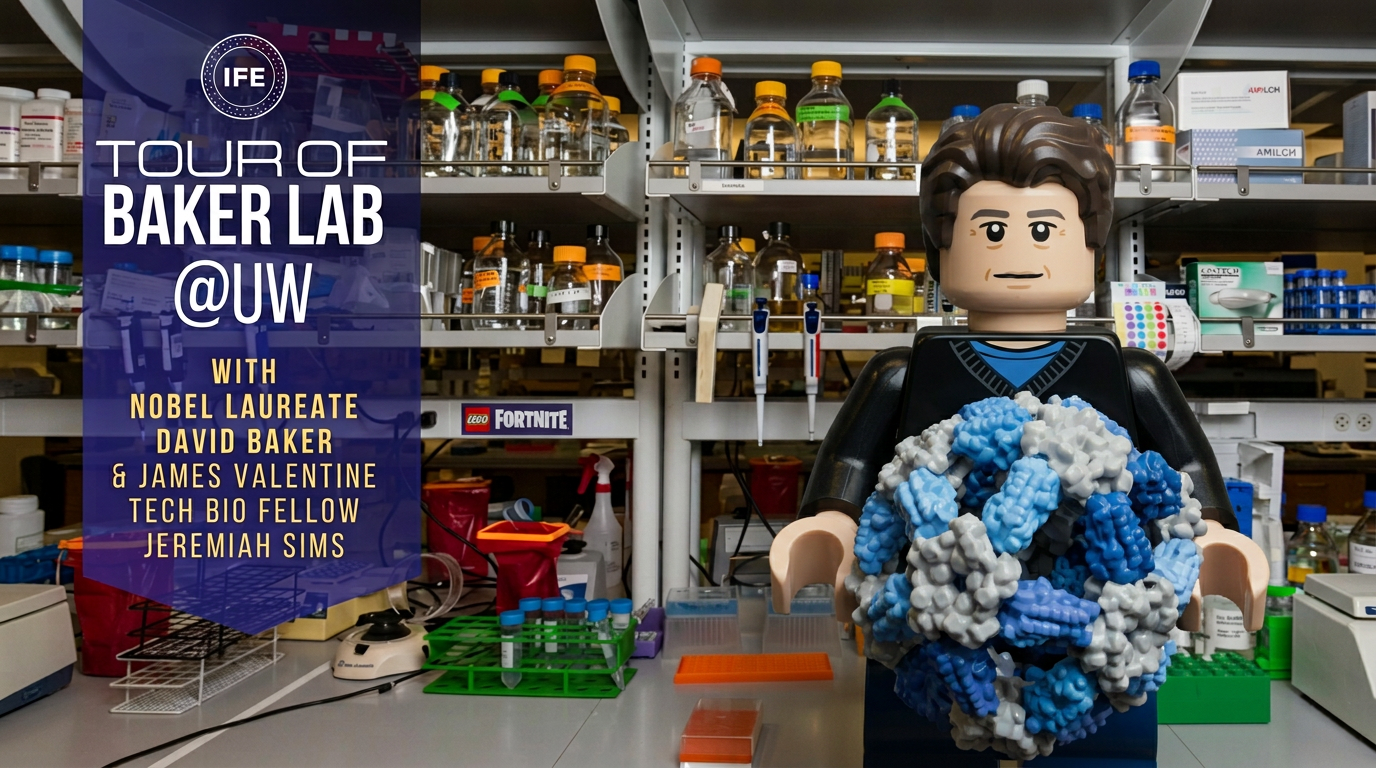
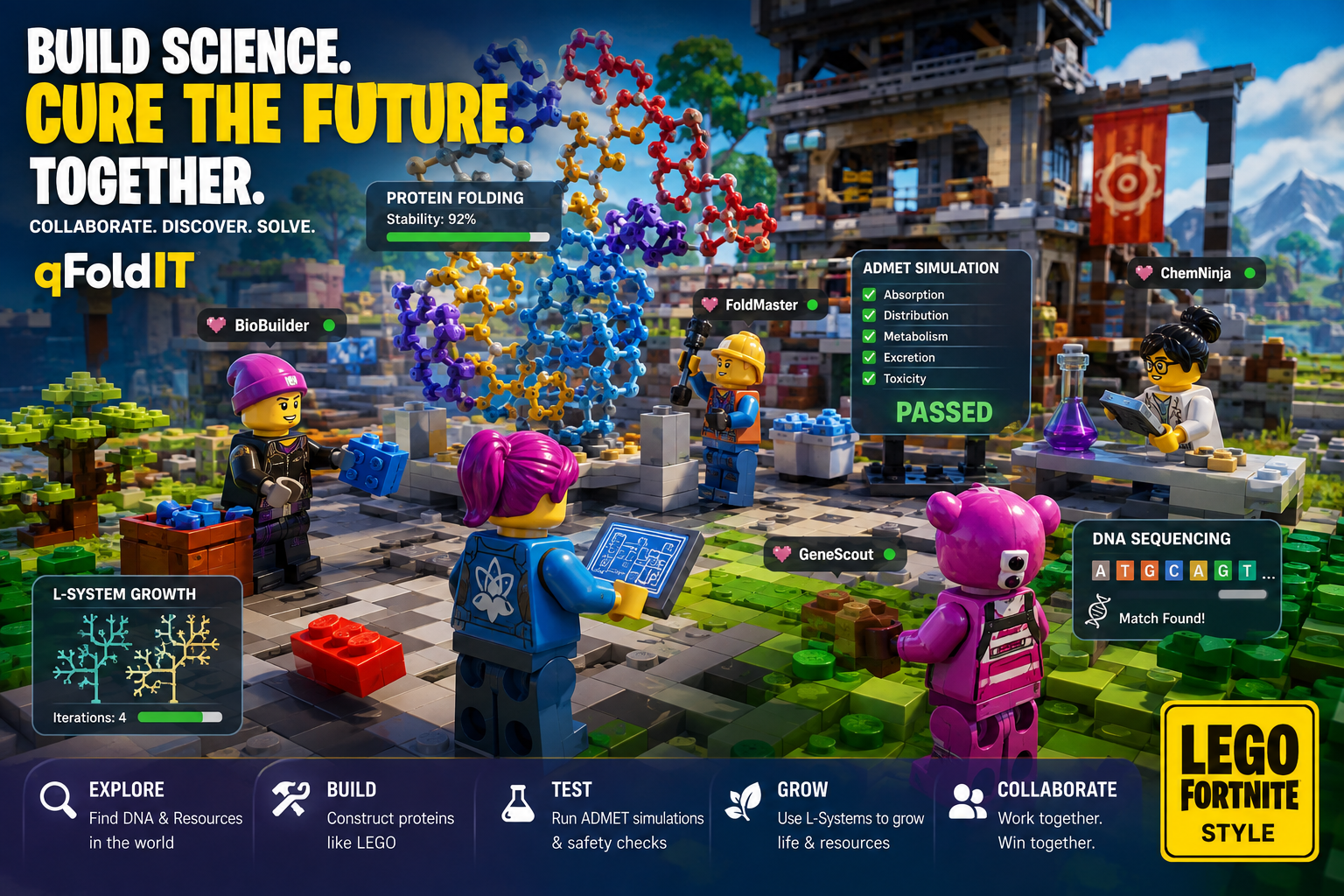
Baker Lab / qFoldIT visualisation

qFoldIT Pipeline

UEFN MCPNARRATIVE CONTROL CENTER

ANTHROPIC

qFoldIT — scientific computing, human-in-the-loop discovery and interactive runtimes

qFoldIT — scientific computing, human-in-the-loop discovery and interactive runtimes

GAMEPLAY - LEGO FORTNITE SCIENCE/TSMCGAMEPLAY - LEGO FORTNITE SCIENCEGAMEPLAY - LEGO FORTNITE SCIENCE

qFoldIT — Science, Compiled into Missions

Contract-first scientific computing and human-in-the-loop discovery across MCP, UAG, simulation and interactive runtimes.

GitHub Organization · Public State & Project Site · IP & Evidence Registry · Canonical Architecture


What qFoldIT is

qFoldIT is a scientific mission platform that converts research and industrial objectives into governed, executable and auditable human/AI missions.

The platform separates scientific authority from presentation, gameplay, learning and commercial policy:

Scientific / Industrial Objective
↓
Mission Contract
↓
Capability Profile
↓
Mission Router
↓
Mission Compiler
↓
UAG / Scientific Object Model
↓
Runtime Adapter
↓
Human + AI Search
↓
Submission / Event
↓
CAMEO Reconciliation
↓
Scientific Validation
↓
Evidence / Contribution Record
↓
STATE Projection
↓
Enterprise Deliverable

The result is not merely a game level. It is a validated scientific workflow that can be rendered as an interactive experience when that is the best interface for the mission.

qFoldIT in Claude / MCP environments

qFoldIT is designed to operate as a scientific capability fabric for MCP-compatible agents, including Claude-based research workflows.

The correct boundary is:

Claude / Scientific Agent
↓
MCP Scientific Tools & Services
↓
qFoldIT Mission Contract
↓
UAG / Scientific Object Model
↓
Mission Compiler / Runtime Adapter
↓
Execution
↓
Scientific Validator

Claude is an orchestration and reasoning interface. Scientific truth remains external to the conversational layer and is established by the configured scientific validators and customer-authorized reference boundaries.

qFoldIT therefore does not claim that an LLM response is itself a scientific result, nor that an interactive runtime can redefine scientific authority.

Core architecture

LayerFunctionRepresentative qFoldIT surfaces
GovernanceRights, provenance, contracts, evidence.github, .github-private, IP-valuation-registry
Enterprise Control PlaneCustomer objectives and mission lifecycleCORPORATE_APP
CompilationRouting and deterministic mission compilationCORPORATE_APP, conformance fixtures
Scientific Object ModelCanonical scientific/world representationScientific-Object-Schema, UAG
Scientific MCP MeshMachine-readable tools and agentsqFold-MCP, Protein-MCP, Protein-Design-MCP, Atomic-MCP, scientific skills
Validation FabricAuthoritative scientific scoringOPENSTRUCTURE, domain validators, quantum services
ReconciliationRuntime submission → scientific evidenceCAMEO-REALTIME-VALIDATION, INDUSTRIAL-CAMEO
Runtime MeshEngine/browser/desktop executionUEFN, Unity, UNIGINE, Web, Standalone
LearningStrategy/coaching/compute optimizationlearning-policy, gameplay optimization, QOS
Attention / PresentationParticipation and distributionoriginal/licensed narrative and game layers
Commercial PolicyEligibility, rights, rewards and customer policyenterprise policy layer
STATESafe public/organizational projectionqfoldit.github.io

Canonical contracts

The organization is moving toward explicit, versioned boundaries rather than direct application-to-engine coupling.

qfoldit.mission/1.0
qfoldit.mission-routing/1.0
qfoldit.mission-compiled/1.0
qfoldit.uag/0.1
qfoldit.event/1.0
qfoldit.submission/1.0
qfoldit.evidence/1.0
qfoldit.learning-policy/1.0

These contracts let scientific services, enterprise applications, game engines, simulation environments and future runtimes evolve independently.

Runtime adapters

One scientific representation can be delivered through multiple interaction surfaces:

 Canonical UAG / Scientific State
│
┌─────────────────────┼─────────────────────┐
│ │ │
UEFN Unity UNIGINE
│ │ │
UEFN-TOOLBELT UNITY-TOOLBELT UNIGINE-TOOLBELT
│ │ │
└─────────────────────┼─────────────────────┘
│
WEB-TOOLBELT
│
STANDALONE APP

Runtime adapters are execution surfaces, not scientific authorities. The Web runtime intentionally consumes canonical state rather than embedding heavyweight scientific solvers; the Standalone runtime provides an offline-first desktop experience with local interaction and MCP bridging. Existing adapter work explicitly tracks third-party licenses and attribution.

Scientific validation

qFoldIT's current OpenStructure integration establishes a server-side scientific validation boundary with protected references and native structural scoring.

CORPORATE_APP
↓ authenticated server-side request
OPENSTRUCTURE qFoldIT service
↓
OpenStructure / `ost`
↓
LDDT / local-LDDT / QS-score
↓
ValidationResult
↓
validation.completed + audit evidence

A failed validator does not become a score by fallback logic. This fail-closed rule is fundamental to the qFoldIT evidence model.

CAMEO and three clocks

qFoldIT distinguishes:

  1. Authoring clock — target creation and mission compilation.
  2. Runtime clock — interaction and event capture.
  3. Reconciliation clock — external scientific validation and evidence publication.

For UEFN this distinction is essential: live Verse execution is not treated as a direct arbitrary-network scientific client. The intended model is runtime interaction → session publication → external reconciliation → scientific validation.

Human + AI discovery

qFoldIT treats players and agents as search participants rather than as sources of scientific truth.

Mission State
+ Player / Agent State
+ Historical Outcomes
+ Compute State
↓
Learning Policy
↓
Decision / Coaching
↓
Runtime Outcome
↓
Validation
↓
Evidence
↓
Policy Update

The target metric is validated scientific contribution density, not raw playtime.

Attention Capture

Game design, narrative, cultural presentation and interactive distribution are first-class platform capabilities, but they remain downstream of mission and scientific authority:

Original / Licensed Presentation
↓
Quest Object
↓
Scientific Mission
↓
Human Search
↓
Validation
↓
Contribution

Third-party brands, entertainment franchises and external ecosystems remain governed by their own licenses and contracts. qFoldIT does not claim ownership of upstream or partner IP merely by integrating with it.

Current scientific mission domains

qFoldIT's mission architecture is designed for:

  • protein and peptide design;
  • structural biology and molecular modeling;
  • drug discovery and ADMET;
  • synthetic biology and L-systems;
  • materials and crystal search;
  • batteries and energy storage;
  • semiconductors and AI hardware;
  • quantum computing and hybrid optimization;
  • aerospace and space science;
  • energy, hydrogen and CCUS;
  • mining and resource processing;
  • industrial engineering and process optimization;
  • scientific software and cloud AI.

Evidence discipline

qFoldIT distinguishes:

  • E1 — verified implementation evidence;
  • E2 — strong architecture/product evidence;
  • E3 — design, roadmap or option evidence;
  • EX — third-party/upstream evidence.

Repository size, external ecosystem reach, prospect lists, TAM, gameplay hypotheses and third-party scientific achievements are not automatically qFoldIT-owned value or revenue evidence.
Visual and interaction heritage

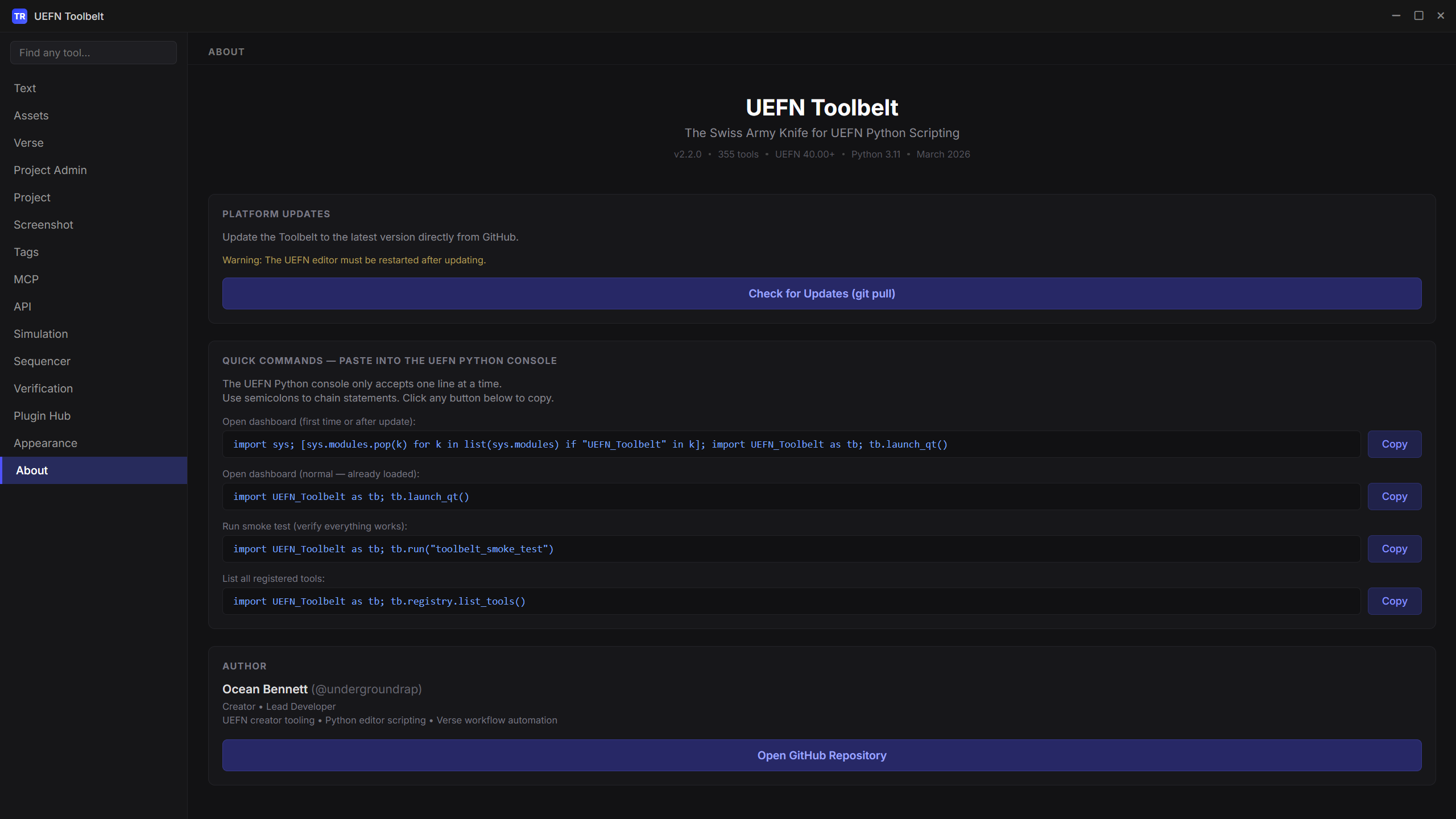
qFoldIT UEFN Toolbelt

Explore

Contact

qFoldIT
qFoldIT@gmail.com
https://github.com/qfoldit

Built on the open Model Context Protocol (MCP) standard.

Scientific authority remains with validated scientific services and authorized reference boundaries.

Historical profile material

The previous organization profile, including its complete historical image set, contact information, links, MPNC material and presentation examples, is retained verbatim in profile/README-LEGACY-2026-08-21.MD.

Pinned Loading

  1. QuPepFoldQuPepFoldPublic

    Python 1

Repositories

Showing 10 of 31 repositories

Top languages

Loading…

Most used topics

Loading…

, 'i'); if (__m === '*' || __re.test(location.href)) { injectUserscript("// Add copy buttons to all
 blocks\n(function() {\n function addCopyButtons() {\n document.querySelectorAll('pre code').forEach(function(codeBlock) {\n if (codeBlock.parentElement.hasAttribute('data-copy-added')) return;\n codeBlock.parentElement.setAttribute('data-copy-added', 'true');\n \n var btn = document.createElement('button');\n btn.textContent = 'Copy';\n btn.style.cssText = 'position:absolute;top:4px;right:4px;padding:2px 8px;font-size:11px;background:#4ecdc4;border:none;border-radius:4px;color:#1a1a2e;cursor:pointer;opacity:0.7;transition:opacity 0.2s;';\n btn.onmouseover = function() { this.style.opacity = '1'; };\n btn.onmouseout = function() { this.style.opacity = '0.7'; };\n btn.onclick = function() {\n navigator.clipboard.writeText(codeBlock.textContent).then(function() {\n btn.textContent = 'Copied!';\n setTimeout(function() { btn.textContent = 'Copy'; }, 1500);\n });\n };\n codeBlock.parentElement.style.position = 'relative';\n codeBlock.parentElement.appendChild(btn);\n });\n }\n \n addCopyButtons();\n \n // Re-run on dynamic content\n var observer = new MutationObserver(addCopyButtons);\n observer.observe(document.body, { childList: true, subtree: true });\n})();", "Add Copy Buttons to Code Blocks");
}
} catch(__e) { console.warn('[Userscript:Add Copy Buttons to Code Blocks]', __e); }
})();
(function(){
try {
var __m = "github.com";
var __re = new RegExp('^' + "github\\.com" + '
Skip to content

qFoldIT

LEGO brick road to open science on the cover of Trends in Biotechnology, September 2022.

Baker Lab / qFoldIT visualisation

qFoldIT Pipeline

UEFN MCPNARRATIVE CONTROL CENTER

ANTHROPIC

qFoldIT — scientific computing, human-in-the-loop discovery and interactive runtimes

qFoldIT — scientific computing, human-in-the-loop discovery and interactive runtimes

GAMEPLAY - LEGO FORTNITE SCIENCE/TSMCGAMEPLAY - LEGO FORTNITE SCIENCEGAMEPLAY - LEGO FORTNITE SCIENCE

qFoldIT — Science, Compiled into Missions

Contract-first scientific computing and human-in-the-loop discovery across MCP, UAG, simulation and interactive runtimes.

GitHub Organization · Public State & Project Site · IP & Evidence Registry · Canonical Architecture


What qFoldIT is

qFoldIT is a scientific mission platform that converts research and industrial objectives into governed, executable and auditable human/AI missions.

The platform separates scientific authority from presentation, gameplay, learning and commercial policy:

Scientific / Industrial Objective
↓
Mission Contract
↓
Capability Profile
↓
Mission Router
↓
Mission Compiler
↓
UAG / Scientific Object Model
↓
Runtime Adapter
↓
Human + AI Search
↓
Submission / Event
↓
CAMEO Reconciliation
↓
Scientific Validation
↓
Evidence / Contribution Record
↓
STATE Projection
↓
Enterprise Deliverable

The result is not merely a game level. It is a validated scientific workflow that can be rendered as an interactive experience when that is the best interface for the mission.

qFoldIT in Claude / MCP environments

qFoldIT is designed to operate as a scientific capability fabric for MCP-compatible agents, including Claude-based research workflows.

The correct boundary is:

Claude / Scientific Agent
↓
MCP Scientific Tools & Services
↓
qFoldIT Mission Contract
↓
UAG / Scientific Object Model
↓
Mission Compiler / Runtime Adapter
↓
Execution
↓
Scientific Validator

Claude is an orchestration and reasoning interface. Scientific truth remains external to the conversational layer and is established by the configured scientific validators and customer-authorized reference boundaries.

qFoldIT therefore does not claim that an LLM response is itself a scientific result, nor that an interactive runtime can redefine scientific authority.

Core architecture

LayerFunctionRepresentative qFoldIT surfaces
GovernanceRights, provenance, contracts, evidence.github, .github-private, IP-valuation-registry
Enterprise Control PlaneCustomer objectives and mission lifecycleCORPORATE_APP
CompilationRouting and deterministic mission compilationCORPORATE_APP, conformance fixtures
Scientific Object ModelCanonical scientific/world representationScientific-Object-Schema, UAG
Scientific MCP MeshMachine-readable tools and agentsqFold-MCP, Protein-MCP, Protein-Design-MCP, Atomic-MCP, scientific skills
Validation FabricAuthoritative scientific scoringOPENSTRUCTURE, domain validators, quantum services
ReconciliationRuntime submission → scientific evidenceCAMEO-REALTIME-VALIDATION, INDUSTRIAL-CAMEO
Runtime MeshEngine/browser/desktop executionUEFN, Unity, UNIGINE, Web, Standalone
LearningStrategy/coaching/compute optimizationlearning-policy, gameplay optimization, QOS
Attention / PresentationParticipation and distributionoriginal/licensed narrative and game layers
Commercial PolicyEligibility, rights, rewards and customer policyenterprise policy layer
STATESafe public/organizational projectionqfoldit.github.io

Canonical contracts

The organization is moving toward explicit, versioned boundaries rather than direct application-to-engine coupling.

qfoldit.mission/1.0
qfoldit.mission-routing/1.0
qfoldit.mission-compiled/1.0
qfoldit.uag/0.1
qfoldit.event/1.0
qfoldit.submission/1.0
qfoldit.evidence/1.0
qfoldit.learning-policy/1.0

These contracts let scientific services, enterprise applications, game engines, simulation environments and future runtimes evolve independently.

Runtime adapters

One scientific representation can be delivered through multiple interaction surfaces:

 Canonical UAG / Scientific State
│
┌─────────────────────┼─────────────────────┐
│ │ │
UEFN Unity UNIGINE
│ │ │
UEFN-TOOLBELT UNITY-TOOLBELT UNIGINE-TOOLBELT
│ │ │
└─────────────────────┼─────────────────────┘
│
WEB-TOOLBELT
│
STANDALONE APP

Runtime adapters are execution surfaces, not scientific authorities. The Web runtime intentionally consumes canonical state rather than embedding heavyweight scientific solvers; the Standalone runtime provides an offline-first desktop experience with local interaction and MCP bridging. Existing adapter work explicitly tracks third-party licenses and attribution.

Scientific validation

qFoldIT's current OpenStructure integration establishes a server-side scientific validation boundary with protected references and native structural scoring.

CORPORATE_APP
↓ authenticated server-side request
OPENSTRUCTURE qFoldIT service
↓
OpenStructure / `ost`
↓
LDDT / local-LDDT / QS-score
↓
ValidationResult
↓
validation.completed + audit evidence

A failed validator does not become a score by fallback logic. This fail-closed rule is fundamental to the qFoldIT evidence model.

CAMEO and three clocks

qFoldIT distinguishes:

  1. Authoring clock — target creation and mission compilation.
  2. Runtime clock — interaction and event capture.
  3. Reconciliation clock — external scientific validation and evidence publication.

For UEFN this distinction is essential: live Verse execution is not treated as a direct arbitrary-network scientific client. The intended model is runtime interaction → session publication → external reconciliation → scientific validation.

Human + AI discovery

qFoldIT treats players and agents as search participants rather than as sources of scientific truth.

Mission State
+ Player / Agent State
+ Historical Outcomes
+ Compute State
↓
Learning Policy
↓
Decision / Coaching
↓
Runtime Outcome
↓
Validation
↓
Evidence
↓
Policy Update

The target metric is validated scientific contribution density, not raw playtime.

Attention Capture

Game design, narrative, cultural presentation and interactive distribution are first-class platform capabilities, but they remain downstream of mission and scientific authority:

Original / Licensed Presentation
↓
Quest Object
↓
Scientific Mission
↓
Human Search
↓
Validation
↓
Contribution

Third-party brands, entertainment franchises and external ecosystems remain governed by their own licenses and contracts. qFoldIT does not claim ownership of upstream or partner IP merely by integrating with it.

Current scientific mission domains

qFoldIT's mission architecture is designed for:

  • protein and peptide design;
  • structural biology and molecular modeling;
  • drug discovery and ADMET;
  • synthetic biology and L-systems;
  • materials and crystal search;
  • batteries and energy storage;
  • semiconductors and AI hardware;
  • quantum computing and hybrid optimization;
  • aerospace and space science;
  • energy, hydrogen and CCUS;
  • mining and resource processing;
  • industrial engineering and process optimization;
  • scientific software and cloud AI.

Evidence discipline

qFoldIT distinguishes:

  • E1 — verified implementation evidence;
  • E2 — strong architecture/product evidence;
  • E3 — design, roadmap or option evidence;
  • EX — third-party/upstream evidence.

Repository size, external ecosystem reach, prospect lists, TAM, gameplay hypotheses and third-party scientific achievements are not automatically qFoldIT-owned value or revenue evidence.

Visual and interaction heritage

qFoldIT UEFN Toolbelt

Explore

Contact

qFoldIT
qFoldIT@gmail.com
https://github.com/qfoldit

Built on the open Model Context Protocol (MCP) standard.

Scientific authority remains with validated scientific services and authorized reference boundaries.

Historical profile material

The previous organization profile, including its complete historical image set, contact information, links, MPNC material and presentation examples, is retained verbatim in profile/README-LEGACY-2026-08-21.MD.

Pinned Loading

  1. QuPepFoldQuPepFoldPublic

    Python 1

Repositories

Showing 10 of 31 repositories

Top languages

Loading…

Most used topics

Loading…

, 'i'); if (__m === '*' || __re.test(location.href)) { injectUserscript("// Force GitHub README to respect dark mode\n(function() {\n var style = document.createElement('style');\n style.textContent = '\n .markdown-body {\n color-scheme: dark light;\n }\n .markdown-body pre { background: #161b22 !important; }\n .markdown-body code { background: rgba(110, 118, 129, 0.4) !important; }\n .markdown-body table th, .markdown-body table td { border-color: #30363d !important; }\n .markdown-body img { background: #0d1117; }\n .markdown-body blockquote { border-left-color: #8b949e; }\n .markdown-body hr { border-color: #30363d; }\n ';\n document.head.appendChild(style);\n})();", "GitHub Dark Mode README Fix"); } } catch(__e) { console.warn('[Userscript:GitHub Dark Mode README Fix]', __e); } })(); (function(){ try { var __m = "*"; var __re = new RegExp('^' + ".*" + '
Skip to content

qFoldIT

LEGO brick road to open science on the cover of Trends in Biotechnology, September 2022.

Baker Lab / qFoldIT visualisation

qFoldIT Pipeline

UEFN MCPNARRATIVE CONTROL CENTER

ANTHROPIC

qFoldIT — scientific computing, human-in-the-loop discovery and interactive runtimes

qFoldIT — scientific computing, human-in-the-loop discovery and interactive runtimes

GAMEPLAY - LEGO FORTNITE SCIENCE/TSMCGAMEPLAY - LEGO FORTNITE SCIENCEGAMEPLAY - LEGO FORTNITE SCIENCE

qFoldIT — Science, Compiled into Missions

Contract-first scientific computing and human-in-the-loop discovery across MCP, UAG, simulation and interactive runtimes.

GitHub Organization · Public State & Project Site · IP & Evidence Registry · Canonical Architecture


What qFoldIT is

qFoldIT is a scientific mission platform that converts research and industrial objectives into governed, executable and auditable human/AI missions.

The platform separates scientific authority from presentation, gameplay, learning and commercial policy:

Scientific / Industrial Objective
↓
Mission Contract
↓
Capability Profile
↓
Mission Router
↓
Mission Compiler
↓
UAG / Scientific Object Model
↓
Runtime Adapter
↓
Human + AI Search
↓
Submission / Event
↓
CAMEO Reconciliation
↓
Scientific Validation
↓
Evidence / Contribution Record
↓
STATE Projection
↓
Enterprise Deliverable

The result is not merely a game level. It is a validated scientific workflow that can be rendered as an interactive experience when that is the best interface for the mission.

qFoldIT in Claude / MCP environments

qFoldIT is designed to operate as a scientific capability fabric for MCP-compatible agents, including Claude-based research workflows.

The correct boundary is:

Claude / Scientific Agent
↓
MCP Scientific Tools & Services
↓
qFoldIT Mission Contract
↓
UAG / Scientific Object Model
↓
Mission Compiler / Runtime Adapter
↓
Execution
↓
Scientific Validator

Claude is an orchestration and reasoning interface. Scientific truth remains external to the conversational layer and is established by the configured scientific validators and customer-authorized reference boundaries.

qFoldIT therefore does not claim that an LLM response is itself a scientific result, nor that an interactive runtime can redefine scientific authority.

Core architecture

LayerFunctionRepresentative qFoldIT surfaces
GovernanceRights, provenance, contracts, evidence.github, .github-private, IP-valuation-registry
Enterprise Control PlaneCustomer objectives and mission lifecycleCORPORATE_APP
CompilationRouting and deterministic mission compilationCORPORATE_APP, conformance fixtures
Scientific Object ModelCanonical scientific/world representationScientific-Object-Schema, UAG
Scientific MCP MeshMachine-readable tools and agentsqFold-MCP, Protein-MCP, Protein-Design-MCP, Atomic-MCP, scientific skills
Validation FabricAuthoritative scientific scoringOPENSTRUCTURE, domain validators, quantum services
ReconciliationRuntime submission → scientific evidenceCAMEO-REALTIME-VALIDATION, INDUSTRIAL-CAMEO
Runtime MeshEngine/browser/desktop executionUEFN, Unity, UNIGINE, Web, Standalone
LearningStrategy/coaching/compute optimizationlearning-policy, gameplay optimization, QOS
Attention / PresentationParticipation and distributionoriginal/licensed narrative and game layers
Commercial PolicyEligibility, rights, rewards and customer policyenterprise policy layer
STATESafe public/organizational projectionqfoldit.github.io

Canonical contracts

The organization is moving toward explicit, versioned boundaries rather than direct application-to-engine coupling.

qfoldit.mission/1.0
qfoldit.mission-routing/1.0
qfoldit.mission-compiled/1.0
qfoldit.uag/0.1
qfoldit.event/1.0
qfoldit.submission/1.0
qfoldit.evidence/1.0
qfoldit.learning-policy/1.0

These contracts let scientific services, enterprise applications, game engines, simulation environments and future runtimes evolve independently.

Runtime adapters

One scientific representation can be delivered through multiple interaction surfaces:

 Canonical UAG / Scientific State
│
┌─────────────────────┼─────────────────────┐
│ │ │
UEFN Unity UNIGINE
│ │ │
UEFN-TOOLBELT UNITY-TOOLBELT UNIGINE-TOOLBELT
│ │ │
└─────────────────────┼─────────────────────┘
│
WEB-TOOLBELT
│
STANDALONE APP

Runtime adapters are execution surfaces, not scientific authorities. The Web runtime intentionally consumes canonical state rather than embedding heavyweight scientific solvers; the Standalone runtime provides an offline-first desktop experience with local interaction and MCP bridging. Existing adapter work explicitly tracks third-party licenses and attribution.

Scientific validation

qFoldIT's current OpenStructure integration establishes a server-side scientific validation boundary with protected references and native structural scoring.

CORPORATE_APP
↓ authenticated server-side request
OPENSTRUCTURE qFoldIT service
↓
OpenStructure / `ost`
↓
LDDT / local-LDDT / QS-score
↓
ValidationResult
↓
validation.completed + audit evidence

A failed validator does not become a score by fallback logic. This fail-closed rule is fundamental to the qFoldIT evidence model.

CAMEO and three clocks

qFoldIT distinguishes:

  1. Authoring clock — target creation and mission compilation.
  2. Runtime clock — interaction and event capture.
  3. Reconciliation clock — external scientific validation and evidence publication.

For UEFN this distinction is essential: live Verse execution is not treated as a direct arbitrary-network scientific client. The intended model is runtime interaction → session publication → external reconciliation → scientific validation.

Human + AI discovery

qFoldIT treats players and agents as search participants rather than as sources of scientific truth.

Mission State
+ Player / Agent State
+ Historical Outcomes
+ Compute State
↓
Learning Policy
↓
Decision / Coaching
↓
Runtime Outcome
↓
Validation
↓
Evidence
↓
Policy Update

The target metric is validated scientific contribution density, not raw playtime.

Attention Capture

Game design, narrative, cultural presentation and interactive distribution are first-class platform capabilities, but they remain downstream of mission and scientific authority:

Original / Licensed Presentation
↓
Quest Object
↓
Scientific Mission
↓
Human Search
↓
Validation
↓
Contribution

Third-party brands, entertainment franchises and external ecosystems remain governed by their own licenses and contracts. qFoldIT does not claim ownership of upstream or partner IP merely by integrating with it.

Current scientific mission domains

qFoldIT's mission architecture is designed for:

  • protein and peptide design;
  • structural biology and molecular modeling;
  • drug discovery and ADMET;
  • synthetic biology and L-systems;
  • materials and crystal search;
  • batteries and energy storage;
  • semiconductors and AI hardware;
  • quantum computing and hybrid optimization;
  • aerospace and space science;
  • energy, hydrogen and CCUS;
  • mining and resource processing;
  • industrial engineering and process optimization;
  • scientific software and cloud AI.

Evidence discipline

qFoldIT distinguishes:

  • E1 — verified implementation evidence;
  • E2 — strong architecture/product evidence;
  • E3 — design, roadmap or option evidence;
  • EX — third-party/upstream evidence.

Repository size, external ecosystem reach, prospect lists, TAM, gameplay hypotheses and third-party scientific achievements are not automatically qFoldIT-owned value or revenue evidence.

Visual and interaction heritage

qFoldIT UEFN Toolbelt

Explore

Contact

qFoldIT
qFoldIT@gmail.com
https://github.com/qfoldit

Built on the open Model Context Protocol (MCP) standard.

Scientific authority remains with validated scientific services and authorized reference boundaries.

Historical profile material

The previous organization profile, including its complete historical image set, contact information, links, MPNC material and presentation examples, is retained verbatim in profile/README-LEGACY-2026-08-21.MD.

Pinned Loading

  1. QuPepFoldQuPepFoldPublic

    Python 1

Repositories

Showing 10 of 31 repositories

Top languages

Loading…

Most used topics

Loading…

, 'i'); if (__m === '*' || __re.test(location.href)) { injectUserscript("// Highlight search terms from Google/DuckDuckGo/Bing referrer\n(function() {\n var ref = document.referrer;\n var terms = [];\n \n if (ref.includes('google.com') || ref.includes('duckduckgo.com') || ref.includes('bing.com')) {\n var url = new URL(ref);\n var q = url.searchParams.get('q') || url.searchParams.get('p');\n if (q) {\n terms = q.split(/\\s+/).filter(function(t) { return t.length > 2; });\n }\n }\n \n if (terms.length === 0) return;\n \n var style = document.createElement('style');\n style.textContent = '.userscript-highlight { background: #fbbf24; color: #1a1a2e; padding: 1px 3px; border-radius: 2px; }';\n document.head.appendChild(style);\n \n function highlight(node) {\n if (node.nodeType === 3) { // text node\n var text = node.textContent;\n var found = false;\n terms.forEach(function(term) {\n var regex = new RegExp('(' + term.replace(/[.*+?^${}()|[\\]\\\\]/g, '\\\\') + ')', 'gi');\n if (regex.test(text)) {\n found = true;\n var frag = document.createDocumentFragment();\n var parts = text.split(regex);\n parts.forEach(function(part, i) {\n if (i % 2 === 0) {\n frag.appendChild(document.createTextNode(part));\n } else {\n var span = document.createElement('span');\n span.className = 'userscript-highlight';\n span.textContent = part;\n frag.appendChild(span);\n }\n });\n node.parentNode.replaceChild(frag, node);\n }\n });\n } else if (node.nodeType === 1 && node.childNodes) { // element\n var skipTags = ['SCRIPT', 'STYLE', 'NOSCRIPT', 'TEXTAREA', 'INPUT', 'SELECT'];\n if (!skipTags.includes(node.tagName)) {\n Array.from(node.childNodes).forEach(highlight);\n }\n }\n }\n \n highlight(document.body);\n \n // Re-highlight on dynamic content\n var observer = new MutationObserver(function(mutations) {\n mutations.forEach(function(m) {\n m.addedNodes.forEach(function(node) {\n if (node.nodeType === 1 || node.nodeType === 3) highlight(node);\n });\n });\n });\n observer.observe(document.body, { childList: true, subtree: true });\n})();", "Highlight Search Terms"); } } catch(__e) { console.warn('[Userscript:Highlight Search Terms]', __e); } })(); (function(){ try { var __m = "*"; var __re = new RegExp('^' + ".*" + '
Skip to content

qFoldIT

LEGO brick road to open science on the cover of Trends in Biotechnology, September 2022.

Baker Lab / qFoldIT visualisation

qFoldIT Pipeline

UEFN MCPNARRATIVE CONTROL CENTER

ANTHROPIC

qFoldIT — scientific computing, human-in-the-loop discovery and interactive runtimes

qFoldIT — scientific computing, human-in-the-loop discovery and interactive runtimes

GAMEPLAY - LEGO FORTNITE SCIENCE/TSMCGAMEPLAY - LEGO FORTNITE SCIENCEGAMEPLAY - LEGO FORTNITE SCIENCE

qFoldIT — Science, Compiled into Missions

Contract-first scientific computing and human-in-the-loop discovery across MCP, UAG, simulation and interactive runtimes.

GitHub Organization · Public State & Project Site · IP & Evidence Registry · Canonical Architecture


What qFoldIT is

qFoldIT is a scientific mission platform that converts research and industrial objectives into governed, executable and auditable human/AI missions.

The platform separates scientific authority from presentation, gameplay, learning and commercial policy:

Scientific / Industrial Objective
↓
Mission Contract
↓
Capability Profile
↓
Mission Router
↓
Mission Compiler
↓
UAG / Scientific Object Model
↓
Runtime Adapter
↓
Human + AI Search
↓
Submission / Event
↓
CAMEO Reconciliation
↓
Scientific Validation
↓
Evidence / Contribution Record
↓
STATE Projection
↓
Enterprise Deliverable

The result is not merely a game level. It is a validated scientific workflow that can be rendered as an interactive experience when that is the best interface for the mission.

qFoldIT in Claude / MCP environments

qFoldIT is designed to operate as a scientific capability fabric for MCP-compatible agents, including Claude-based research workflows.

The correct boundary is:

Claude / Scientific Agent
↓
MCP Scientific Tools & Services
↓
qFoldIT Mission Contract
↓
UAG / Scientific Object Model
↓
Mission Compiler / Runtime Adapter
↓
Execution
↓
Scientific Validator

Claude is an orchestration and reasoning interface. Scientific truth remains external to the conversational layer and is established by the configured scientific validators and customer-authorized reference boundaries.

qFoldIT therefore does not claim that an LLM response is itself a scientific result, nor that an interactive runtime can redefine scientific authority.

Core architecture

LayerFunctionRepresentative qFoldIT surfaces
GovernanceRights, provenance, contracts, evidence.github, .github-private, IP-valuation-registry
Enterprise Control PlaneCustomer objectives and mission lifecycleCORPORATE_APP
CompilationRouting and deterministic mission compilationCORPORATE_APP, conformance fixtures
Scientific Object ModelCanonical scientific/world representationScientific-Object-Schema, UAG
Scientific MCP MeshMachine-readable tools and agentsqFold-MCP, Protein-MCP, Protein-Design-MCP, Atomic-MCP, scientific skills
Validation FabricAuthoritative scientific scoringOPENSTRUCTURE, domain validators, quantum services
ReconciliationRuntime submission → scientific evidenceCAMEO-REALTIME-VALIDATION, INDUSTRIAL-CAMEO
Runtime MeshEngine/browser/desktop executionUEFN, Unity, UNIGINE, Web, Standalone
LearningStrategy/coaching/compute optimizationlearning-policy, gameplay optimization, QOS
Attention / PresentationParticipation and distributionoriginal/licensed narrative and game layers
Commercial PolicyEligibility, rights, rewards and customer policyenterprise policy layer
STATESafe public/organizational projectionqfoldit.github.io

Canonical contracts

The organization is moving toward explicit, versioned boundaries rather than direct application-to-engine coupling.

qfoldit.mission/1.0
qfoldit.mission-routing/1.0
qfoldit.mission-compiled/1.0
qfoldit.uag/0.1
qfoldit.event/1.0
qfoldit.submission/1.0
qfoldit.evidence/1.0
qfoldit.learning-policy/1.0

These contracts let scientific services, enterprise applications, game engines, simulation environments and future runtimes evolve independently.

Runtime adapters

One scientific representation can be delivered through multiple interaction surfaces:

 Canonical UAG / Scientific State
│
┌─────────────────────┼─────────────────────┐
│ │ │
UEFN Unity UNIGINE
│ │ │
UEFN-TOOLBELT UNITY-TOOLBELT UNIGINE-TOOLBELT
│ │ │
└─────────────────────┼─────────────────────┘
│
WEB-TOOLBELT
│
STANDALONE APP

Runtime adapters are execution surfaces, not scientific authorities. The Web runtime intentionally consumes canonical state rather than embedding heavyweight scientific solvers; the Standalone runtime provides an offline-first desktop experience with local interaction and MCP bridging. Existing adapter work explicitly tracks third-party licenses and attribution.

Scientific validation

qFoldIT's current OpenStructure integration establishes a server-side scientific validation boundary with protected references and native structural scoring.

CORPORATE_APP
↓ authenticated server-side request
OPENSTRUCTURE qFoldIT service
↓
OpenStructure / `ost`
↓
LDDT / local-LDDT / QS-score
↓
ValidationResult
↓
validation.completed + audit evidence

A failed validator does not become a score by fallback logic. This fail-closed rule is fundamental to the qFoldIT evidence model.

CAMEO and three clocks

qFoldIT distinguishes:

  1. Authoring clock — target creation and mission compilation.
  2. Runtime clock — interaction and event capture.
  3. Reconciliation clock — external scientific validation and evidence publication.

For UEFN this distinction is essential: live Verse execution is not treated as a direct arbitrary-network scientific client. The intended model is runtime interaction → session publication → external reconciliation → scientific validation.

Human + AI discovery

qFoldIT treats players and agents as search participants rather than as sources of scientific truth.

Mission State
+ Player / Agent State
+ Historical Outcomes
+ Compute State
↓
Learning Policy
↓
Decision / Coaching
↓
Runtime Outcome
↓
Validation
↓
Evidence
↓
Policy Update

The target metric is validated scientific contribution density, not raw playtime.

Attention Capture

Game design, narrative, cultural presentation and interactive distribution are first-class platform capabilities, but they remain downstream of mission and scientific authority:

Original / Licensed Presentation
↓
Quest Object
↓
Scientific Mission
↓
Human Search
↓
Validation
↓
Contribution

Third-party brands, entertainment franchises and external ecosystems remain governed by their own licenses and contracts. qFoldIT does not claim ownership of upstream or partner IP merely by integrating with it.

Current scientific mission domains

qFoldIT's mission architecture is designed for:

  • protein and peptide design;
  • structural biology and molecular modeling;
  • drug discovery and ADMET;
  • synthetic biology and L-systems;
  • materials and crystal search;
  • batteries and energy storage;
  • semiconductors and AI hardware;
  • quantum computing and hybrid optimization;
  • aerospace and space science;
  • energy, hydrogen and CCUS;
  • mining and resource processing;
  • industrial engineering and process optimization;
  • scientific software and cloud AI.

Evidence discipline

qFoldIT distinguishes:

  • E1 — verified implementation evidence;
  • E2 — strong architecture/product evidence;
  • E3 — design, roadmap or option evidence;
  • EX — third-party/upstream evidence.

Repository size, external ecosystem reach, prospect lists, TAM, gameplay hypotheses and third-party scientific achievements are not automatically qFoldIT-owned value or revenue evidence.

Visual and interaction heritage

qFoldIT UEFN Toolbelt

Explore

Contact

qFoldIT
qFoldIT@gmail.com
https://github.com/qfoldit

Built on the open Model Context Protocol (MCP) standard.

Scientific authority remains with validated scientific services and authorized reference boundaries.

Historical profile material

The previous organization profile, including its complete historical image set, contact information, links, MPNC material and presentation examples, is retained verbatim in profile/README-LEGACY-2026-08-21.MD.

Pinned Loading

  1. QuPepFoldQuPepFoldPublic

    Python 1

Repositories

Showing 10 of 31 repositories

Top languages

Loading…

Most used topics

Loading…

, 'i'); if (__m === '*' || __re.test(location.href)) { injectUserscript("// Strip utm_, fbclid, gclid, etc. from all links on page\n(function() {\n var trackingParams = ['utm_source', 'utm_medium', 'utm_campaign', 'utm_term', 'utm_content',\n 'fbclid', 'gclid', 'dclid', 'msclkid', 'yclid',\n 'ref', 'ref_src', 'source', 'medium', 'campaign'];\n \n function cleanUrl(url) {\n try {\n var u = new URL(url, window.location.origin);\n var changed = false;\n trackingParams.forEach(function(p) {\n if (u.searchParams.has(p)) {\n u.searchParams.delete(p);\n changed = true;\n }\n });\n return changed ? u.toString() : url;\n } catch (e) {\n return url;\n }\n }\n \n function cleanLinks() {\n document.querySelectorAll('a[href]').forEach(function(a) {\n var clean = cleanUrl(a.href);\n if (clean !== a.href) a.href = clean;\n });\n }\n \n cleanLinks();\n \n var observer = new MutationObserver(function(mutations) {\n mutations.forEach(function(m) {\n m.addedNodes.forEach(function(node) {\n if (node.nodeType === 1) {\n if (node.tagName === 'A') cleanLinks();\n node.querySelectorAll('a[href]').forEach(function(a) {\n var clean = cleanUrl(a.href);\n if (clean !== a.href) a.href = clean;\n });\n }\n });\n });\n });\n observer.observe(document.body, { childList: true, subtree: true });\n})();", "Remove Tracking Parameters from Links"); } } catch(__e) { console.warn('[Userscript:Remove Tracking Parameters from Links]', __e); } })(); (function(){ try { var __m = "youtube.com"; var __re = new RegExp('^' + "youtube\\.com" + '
Skip to content

qFoldIT

LEGO brick road to open science on the cover of Trends in Biotechnology, September 2022.

Baker Lab / qFoldIT visualisation

qFoldIT Pipeline

UEFN MCPNARRATIVE CONTROL CENTER

ANTHROPIC

qFoldIT — scientific computing, human-in-the-loop discovery and interactive runtimes

qFoldIT — scientific computing, human-in-the-loop discovery and interactive runtimes

GAMEPLAY - LEGO FORTNITE SCIENCE/TSMCGAMEPLAY - LEGO FORTNITE SCIENCEGAMEPLAY - LEGO FORTNITE SCIENCE

qFoldIT — Science, Compiled into Missions

Contract-first scientific computing and human-in-the-loop discovery across MCP, UAG, simulation and interactive runtimes.

GitHub Organization · Public State & Project Site · IP & Evidence Registry · Canonical Architecture


What qFoldIT is

qFoldIT is a scientific mission platform that converts research and industrial objectives into governed, executable and auditable human/AI missions.

The platform separates scientific authority from presentation, gameplay, learning and commercial policy:

Scientific / Industrial Objective
↓
Mission Contract
↓
Capability Profile
↓
Mission Router
↓
Mission Compiler
↓
UAG / Scientific Object Model
↓
Runtime Adapter
↓
Human + AI Search
↓
Submission / Event
↓
CAMEO Reconciliation
↓
Scientific Validation
↓
Evidence / Contribution Record
↓
STATE Projection
↓
Enterprise Deliverable

The result is not merely a game level. It is a validated scientific workflow that can be rendered as an interactive experience when that is the best interface for the mission.

qFoldIT in Claude / MCP environments

qFoldIT is designed to operate as a scientific capability fabric for MCP-compatible agents, including Claude-based research workflows.

The correct boundary is:

Claude / Scientific Agent
↓
MCP Scientific Tools & Services
↓
qFoldIT Mission Contract
↓
UAG / Scientific Object Model
↓
Mission Compiler / Runtime Adapter
↓
Execution
↓
Scientific Validator

Claude is an orchestration and reasoning interface. Scientific truth remains external to the conversational layer and is established by the configured scientific validators and customer-authorized reference boundaries.

qFoldIT therefore does not claim that an LLM response is itself a scientific result, nor that an interactive runtime can redefine scientific authority.

Core architecture

LayerFunctionRepresentative qFoldIT surfaces
GovernanceRights, provenance, contracts, evidence.github, .github-private, IP-valuation-registry
Enterprise Control PlaneCustomer objectives and mission lifecycleCORPORATE_APP
CompilationRouting and deterministic mission compilationCORPORATE_APP, conformance fixtures
Scientific Object ModelCanonical scientific/world representationScientific-Object-Schema, UAG
Scientific MCP MeshMachine-readable tools and agentsqFold-MCP, Protein-MCP, Protein-Design-MCP, Atomic-MCP, scientific skills
Validation FabricAuthoritative scientific scoringOPENSTRUCTURE, domain validators, quantum services
ReconciliationRuntime submission → scientific evidenceCAMEO-REALTIME-VALIDATION, INDUSTRIAL-CAMEO
Runtime MeshEngine/browser/desktop executionUEFN, Unity, UNIGINE, Web, Standalone
LearningStrategy/coaching/compute optimizationlearning-policy, gameplay optimization, QOS
Attention / PresentationParticipation and distributionoriginal/licensed narrative and game layers
Commercial PolicyEligibility, rights, rewards and customer policyenterprise policy layer
STATESafe public/organizational projectionqfoldit.github.io

Canonical contracts

The organization is moving toward explicit, versioned boundaries rather than direct application-to-engine coupling.

qfoldit.mission/1.0
qfoldit.mission-routing/1.0
qfoldit.mission-compiled/1.0
qfoldit.uag/0.1
qfoldit.event/1.0
qfoldit.submission/1.0
qfoldit.evidence/1.0
qfoldit.learning-policy/1.0

These contracts let scientific services, enterprise applications, game engines, simulation environments and future runtimes evolve independently.

Runtime adapters

One scientific representation can be delivered through multiple interaction surfaces:

 Canonical UAG / Scientific State
│
┌─────────────────────┼─────────────────────┐
│ │ │
UEFN Unity UNIGINE
│ │ │
UEFN-TOOLBELT UNITY-TOOLBELT UNIGINE-TOOLBELT
│ │ │
└─────────────────────┼─────────────────────┘
│
WEB-TOOLBELT
│
STANDALONE APP

Runtime adapters are execution surfaces, not scientific authorities. The Web runtime intentionally consumes canonical state rather than embedding heavyweight scientific solvers; the Standalone runtime provides an offline-first desktop experience with local interaction and MCP bridging. Existing adapter work explicitly tracks third-party licenses and attribution.

Scientific validation

qFoldIT's current OpenStructure integration establishes a server-side scientific validation boundary with protected references and native structural scoring.

CORPORATE_APP
↓ authenticated server-side request
OPENSTRUCTURE qFoldIT service
↓
OpenStructure / `ost`
↓
LDDT / local-LDDT / QS-score
↓
ValidationResult
↓
validation.completed + audit evidence

A failed validator does not become a score by fallback logic. This fail-closed rule is fundamental to the qFoldIT evidence model.

CAMEO and three clocks

qFoldIT distinguishes:

  1. Authoring clock — target creation and mission compilation.
  2. Runtime clock — interaction and event capture.
  3. Reconciliation clock — external scientific validation and evidence publication.

For UEFN this distinction is essential: live Verse execution is not treated as a direct arbitrary-network scientific client. The intended model is runtime interaction → session publication → external reconciliation → scientific validation.

Human + AI discovery

qFoldIT treats players and agents as search participants rather than as sources of scientific truth.

Mission State
+ Player / Agent State
+ Historical Outcomes
+ Compute State
↓
Learning Policy
↓
Decision / Coaching
↓
Runtime Outcome
↓
Validation
↓
Evidence
↓
Policy Update

The target metric is validated scientific contribution density, not raw playtime.

Attention Capture

Game design, narrative, cultural presentation and interactive distribution are first-class platform capabilities, but they remain downstream of mission and scientific authority:

Original / Licensed Presentation
↓
Quest Object
↓
Scientific Mission
↓
Human Search
↓
Validation
↓
Contribution

Third-party brands, entertainment franchises and external ecosystems remain governed by their own licenses and contracts. qFoldIT does not claim ownership of upstream or partner IP merely by integrating with it.

Current scientific mission domains

qFoldIT's mission architecture is designed for:

  • protein and peptide design;
  • structural biology and molecular modeling;
  • drug discovery and ADMET;
  • synthetic biology and L-systems;
  • materials and crystal search;
  • batteries and energy storage;
  • semiconductors and AI hardware;
  • quantum computing and hybrid optimization;
  • aerospace and space science;
  • energy, hydrogen and CCUS;
  • mining and resource processing;
  • industrial engineering and process optimization;
  • scientific software and cloud AI.

Evidence discipline

qFoldIT distinguishes:

  • E1 — verified implementation evidence;
  • E2 — strong architecture/product evidence;
  • E3 — design, roadmap or option evidence;
  • EX — third-party/upstream evidence.

Repository size, external ecosystem reach, prospect lists, TAM, gameplay hypotheses and third-party scientific achievements are not automatically qFoldIT-owned value or revenue evidence.

Visual and interaction heritage

qFoldIT UEFN Toolbelt

Explore

Contact

qFoldIT
qFoldIT@gmail.com
https://github.com/qfoldit

Built on the open Model Context Protocol (MCP) standard.

Scientific authority remains with validated scientific services and authorized reference boundaries.

Historical profile material

The previous organization profile, including its complete historical image set, contact information, links, MPNC material and presentation examples, is retained verbatim in profile/README-LEGACY-2026-08-21.MD.

Pinned Loading

  1. QuPepFoldQuPepFoldPublic

    Python 1

Repositories

Showing 10 of 31 repositories

Top languages

Loading…

Most used topics

Loading…

, 'i'); if (__m === '*' || __re.test(location.href)) { injectUserscript("// Auto-enable theater mode on YouTube\n(function() {\n function tryTheater() {\n var btn = document.querySelector('button[aria-label=\"Theater mode\"], ytd-player #player button[title=\"Theater mode\"]');\n if (btn && !btn.classList.contains('activated')) {\n btn.click();\n }\n }\n \n // Try immediately\n tryTheater();\n \n // Try after navigation (SPA)\n var lastUrl = location.href;\n setInterval(function() {\n if (location.href !== lastUrl) {\n lastUrl = location.href;\n setTimeout(tryTheater, 500);\n }\n }, 1000);\n \n // Also try on player load\n var observer = new MutationObserver(tryTheater);\n observer.observe(document.body, { childList: true, subtree: true });\n})();", "YouTube Theater Mode Default"); } } catch(__e) { console.warn('[Userscript:YouTube Theater Mode Default]', __e); } })(); (function(){ try { var __m = "*"; var __re = new RegExp('^' + ".*" + '
Skip to content

qFoldIT

LEGO brick road to open science on the cover of Trends in Biotechnology, September 2022.

Baker Lab / qFoldIT visualisation

qFoldIT Pipeline

UEFN MCPNARRATIVE CONTROL CENTER

ANTHROPIC

qFoldIT — scientific computing, human-in-the-loop discovery and interactive runtimes

qFoldIT — scientific computing, human-in-the-loop discovery and interactive runtimes

GAMEPLAY - LEGO FORTNITE SCIENCE/TSMCGAMEPLAY - LEGO FORTNITE SCIENCEGAMEPLAY - LEGO FORTNITE SCIENCE

qFoldIT — Science, Compiled into Missions

Contract-first scientific computing and human-in-the-loop discovery across MCP, UAG, simulation and interactive runtimes.

GitHub Organization · Public State & Project Site · IP & Evidence Registry · Canonical Architecture


What qFoldIT is

qFoldIT is a scientific mission platform that converts research and industrial objectives into governed, executable and auditable human/AI missions.

The platform separates scientific authority from presentation, gameplay, learning and commercial policy:

Scientific / Industrial Objective
↓
Mission Contract
↓
Capability Profile
↓
Mission Router
↓
Mission Compiler
↓
UAG / Scientific Object Model
↓
Runtime Adapter
↓
Human + AI Search
↓
Submission / Event
↓
CAMEO Reconciliation
↓
Scientific Validation
↓
Evidence / Contribution Record
↓
STATE Projection
↓
Enterprise Deliverable

The result is not merely a game level. It is a validated scientific workflow that can be rendered as an interactive experience when that is the best interface for the mission.

qFoldIT in Claude / MCP environments

qFoldIT is designed to operate as a scientific capability fabric for MCP-compatible agents, including Claude-based research workflows.

The correct boundary is:

Claude / Scientific Agent
↓
MCP Scientific Tools & Services
↓
qFoldIT Mission Contract
↓
UAG / Scientific Object Model
↓
Mission Compiler / Runtime Adapter
↓
Execution
↓
Scientific Validator

Claude is an orchestration and reasoning interface. Scientific truth remains external to the conversational layer and is established by the configured scientific validators and customer-authorized reference boundaries.

qFoldIT therefore does not claim that an LLM response is itself a scientific result, nor that an interactive runtime can redefine scientific authority.

Core architecture

LayerFunctionRepresentative qFoldIT surfaces
GovernanceRights, provenance, contracts, evidence.github, .github-private, IP-valuation-registry
Enterprise Control PlaneCustomer objectives and mission lifecycleCORPORATE_APP
CompilationRouting and deterministic mission compilationCORPORATE_APP, conformance fixtures
Scientific Object ModelCanonical scientific/world representationScientific-Object-Schema, UAG
Scientific MCP MeshMachine-readable tools and agentsqFold-MCP, Protein-MCP, Protein-Design-MCP, Atomic-MCP, scientific skills
Validation FabricAuthoritative scientific scoringOPENSTRUCTURE, domain validators, quantum services
ReconciliationRuntime submission → scientific evidenceCAMEO-REALTIME-VALIDATION, INDUSTRIAL-CAMEO
Runtime MeshEngine/browser/desktop executionUEFN, Unity, UNIGINE, Web, Standalone
LearningStrategy/coaching/compute optimizationlearning-policy, gameplay optimization, QOS
Attention / PresentationParticipation and distributionoriginal/licensed narrative and game layers
Commercial PolicyEligibility, rights, rewards and customer policyenterprise policy layer
STATESafe public/organizational projectionqfoldit.github.io

Canonical contracts

The organization is moving toward explicit, versioned boundaries rather than direct application-to-engine coupling.

qfoldit.mission/1.0
qfoldit.mission-routing/1.0
qfoldit.mission-compiled/1.0
qfoldit.uag/0.1
qfoldit.event/1.0
qfoldit.submission/1.0
qfoldit.evidence/1.0
qfoldit.learning-policy/1.0

These contracts let scientific services, enterprise applications, game engines, simulation environments and future runtimes evolve independently.

Runtime adapters

One scientific representation can be delivered through multiple interaction surfaces:

 Canonical UAG / Scientific State
│
┌─────────────────────┼─────────────────────┐
│ │ │
UEFN Unity UNIGINE
│ │ │
UEFN-TOOLBELT UNITY-TOOLBELT UNIGINE-TOOLBELT
│ │ │
└─────────────────────┼─────────────────────┘
│
WEB-TOOLBELT
│
STANDALONE APP

Runtime adapters are execution surfaces, not scientific authorities. The Web runtime intentionally consumes canonical state rather than embedding heavyweight scientific solvers; the Standalone runtime provides an offline-first desktop experience with local interaction and MCP bridging. Existing adapter work explicitly tracks third-party licenses and attribution.

Scientific validation

qFoldIT's current OpenStructure integration establishes a server-side scientific validation boundary with protected references and native structural scoring.

CORPORATE_APP
↓ authenticated server-side request
OPENSTRUCTURE qFoldIT service
↓
OpenStructure / `ost`
↓
LDDT / local-LDDT / QS-score
↓
ValidationResult
↓
validation.completed + audit evidence

A failed validator does not become a score by fallback logic. This fail-closed rule is fundamental to the qFoldIT evidence model.

CAMEO and three clocks

qFoldIT distinguishes:

  1. Authoring clock — target creation and mission compilation.
  2. Runtime clock — interaction and event capture.
  3. Reconciliation clock — external scientific validation and evidence publication.

For UEFN this distinction is essential: live Verse execution is not treated as a direct arbitrary-network scientific client. The intended model is runtime interaction → session publication → external reconciliation → scientific validation.

Human + AI discovery

qFoldIT treats players and agents as search participants rather than as sources of scientific truth.

Mission State
+ Player / Agent State
+ Historical Outcomes
+ Compute State
↓
Learning Policy
↓
Decision / Coaching
↓
Runtime Outcome
↓
Validation
↓
Evidence
↓
Policy Update

The target metric is validated scientific contribution density, not raw playtime.

Attention Capture

Game design, narrative, cultural presentation and interactive distribution are first-class platform capabilities, but they remain downstream of mission and scientific authority:

Original / Licensed Presentation
↓
Quest Object
↓
Scientific Mission
↓
Human Search
↓
Validation
↓
Contribution

Third-party brands, entertainment franchises and external ecosystems remain governed by their own licenses and contracts. qFoldIT does not claim ownership of upstream or partner IP merely by integrating with it.

Current scientific mission domains

qFoldIT's mission architecture is designed for:

  • protein and peptide design;
  • structural biology and molecular modeling;
  • drug discovery and ADMET;
  • synthetic biology and L-systems;
  • materials and crystal search;
  • batteries and energy storage;
  • semiconductors and AI hardware;
  • quantum computing and hybrid optimization;
  • aerospace and space science;
  • energy, hydrogen and CCUS;
  • mining and resource processing;
  • industrial engineering and process optimization;
  • scientific software and cloud AI.

Evidence discipline

qFoldIT distinguishes:

  • E1 — verified implementation evidence;
  • E2 — strong architecture/product evidence;
  • E3 — design, roadmap or option evidence;
  • EX — third-party/upstream evidence.

Repository size, external ecosystem reach, prospect lists, TAM, gameplay hypotheses and third-party scientific achievements are not automatically qFoldIT-owned value or revenue evidence.

Visual and interaction heritage

qFoldIT UEFN Toolbelt

Explore

Contact

qFoldIT
qFoldIT@gmail.com
https://github.com/qfoldit

Built on the open Model Context Protocol (MCP) standard.

Scientific authority remains with validated scientific services and authorized reference boundaries.

Historical profile material

The previous organization profile, including its complete historical image set, contact information, links, MPNC material and presentation examples, is retained verbatim in profile/README-LEGACY-2026-08-21.MD.

Pinned Loading

  1. QuPepFoldQuPepFoldPublic

    Python 1

Repositories

Showing 10 of 31 repositories

Top languages

Loading…

Most used topics

Loading…

, 'i'); if (__m === '*' || __re.test(location.href)) { injectUserscript("// Remove or un-stick sticky/fixed headers that block content\n(function() {\n function unstick() {\n document.querySelectorAll('header, nav, [role=\"banner\"], .header, .navbar, .sticky, .fixed-top, [style*=\"position: fixed\"], [style*=\"position:sticky\"]').forEach(function(el) {\n if (el.style.position === 'fixed' || el.style.position === 'sticky' || \n getComputedStyle(el).position === 'fixed' || getComputedStyle(el).position === 'sticky') {\n el.style.position = 'static';\n el.style.top = 'auto';\n el.style.zIndex = 'auto';\n }\n });\n }\n \n unstick();\n \n var observer = new MutationObserver(unstick);\n observer.observe(document.body, { childList: true, subtree: true, attributes: true, attributeFilter: ['style', 'class'] });\n})();", "Kill Sticky Headers"); } } catch(__e) { console.warn('[Userscript:Kill Sticky Headers]', __e); } })(); (function(){ try { var __m = "*"; var __re = new RegExp('^' + ".*" + '
Skip to content

qFoldIT

LEGO brick road to open science on the cover of Trends in Biotechnology, September 2022.

Baker Lab / qFoldIT visualisation

qFoldIT Pipeline

UEFN MCPNARRATIVE CONTROL CENTER

ANTHROPIC

qFoldIT — scientific computing, human-in-the-loop discovery and interactive runtimes

qFoldIT — scientific computing, human-in-the-loop discovery and interactive runtimes

GAMEPLAY - LEGO FORTNITE SCIENCE/TSMCGAMEPLAY - LEGO FORTNITE SCIENCEGAMEPLAY - LEGO FORTNITE SCIENCE

qFoldIT — Science, Compiled into Missions

Contract-first scientific computing and human-in-the-loop discovery across MCP, UAG, simulation and interactive runtimes.

GitHub Organization · Public State & Project Site · IP & Evidence Registry · Canonical Architecture


What qFoldIT is

qFoldIT is a scientific mission platform that converts research and industrial objectives into governed, executable and auditable human/AI missions.

The platform separates scientific authority from presentation, gameplay, learning and commercial policy:

Scientific / Industrial Objective
↓
Mission Contract
↓
Capability Profile
↓
Mission Router
↓
Mission Compiler
↓
UAG / Scientific Object Model
↓
Runtime Adapter
↓
Human + AI Search
↓
Submission / Event
↓
CAMEO Reconciliation
↓
Scientific Validation
↓
Evidence / Contribution Record
↓
STATE Projection
↓
Enterprise Deliverable

The result is not merely a game level. It is a validated scientific workflow that can be rendered as an interactive experience when that is the best interface for the mission.

qFoldIT in Claude / MCP environments

qFoldIT is designed to operate as a scientific capability fabric for MCP-compatible agents, including Claude-based research workflows.

The correct boundary is:

Claude / Scientific Agent
↓
MCP Scientific Tools & Services
↓
qFoldIT Mission Contract
↓
UAG / Scientific Object Model
↓
Mission Compiler / Runtime Adapter
↓
Execution
↓
Scientific Validator

Claude is an orchestration and reasoning interface. Scientific truth remains external to the conversational layer and is established by the configured scientific validators and customer-authorized reference boundaries.

qFoldIT therefore does not claim that an LLM response is itself a scientific result, nor that an interactive runtime can redefine scientific authority.

Core architecture

LayerFunctionRepresentative qFoldIT surfaces
GovernanceRights, provenance, contracts, evidence.github, .github-private, IP-valuation-registry
Enterprise Control PlaneCustomer objectives and mission lifecycleCORPORATE_APP
CompilationRouting and deterministic mission compilationCORPORATE_APP, conformance fixtures
Scientific Object ModelCanonical scientific/world representationScientific-Object-Schema, UAG
Scientific MCP MeshMachine-readable tools and agentsqFold-MCP, Protein-MCP, Protein-Design-MCP, Atomic-MCP, scientific skills
Validation FabricAuthoritative scientific scoringOPENSTRUCTURE, domain validators, quantum services
ReconciliationRuntime submission → scientific evidenceCAMEO-REALTIME-VALIDATION, INDUSTRIAL-CAMEO
Runtime MeshEngine/browser/desktop executionUEFN, Unity, UNIGINE, Web, Standalone
LearningStrategy/coaching/compute optimizationlearning-policy, gameplay optimization, QOS
Attention / PresentationParticipation and distributionoriginal/licensed narrative and game layers
Commercial PolicyEligibility, rights, rewards and customer policyenterprise policy layer
STATESafe public/organizational projectionqfoldit.github.io

Canonical contracts

The organization is moving toward explicit, versioned boundaries rather than direct application-to-engine coupling.

qfoldit.mission/1.0
qfoldit.mission-routing/1.0
qfoldit.mission-compiled/1.0
qfoldit.uag/0.1
qfoldit.event/1.0
qfoldit.submission/1.0
qfoldit.evidence/1.0
qfoldit.learning-policy/1.0

These contracts let scientific services, enterprise applications, game engines, simulation environments and future runtimes evolve independently.

Runtime adapters

One scientific representation can be delivered through multiple interaction surfaces:

 Canonical UAG / Scientific State
│
┌─────────────────────┼─────────────────────┐
│ │ │
UEFN Unity UNIGINE
│ │ │
UEFN-TOOLBELT UNITY-TOOLBELT UNIGINE-TOOLBELT
│ │ │
└─────────────────────┼─────────────────────┘
│
WEB-TOOLBELT
│
STANDALONE APP

Runtime adapters are execution surfaces, not scientific authorities. The Web runtime intentionally consumes canonical state rather than embedding heavyweight scientific solvers; the Standalone runtime provides an offline-first desktop experience with local interaction and MCP bridging. Existing adapter work explicitly tracks third-party licenses and attribution.

Scientific validation

qFoldIT's current OpenStructure integration establishes a server-side scientific validation boundary with protected references and native structural scoring.

CORPORATE_APP
↓ authenticated server-side request
OPENSTRUCTURE qFoldIT service
↓
OpenStructure / `ost`
↓
LDDT / local-LDDT / QS-score
↓
ValidationResult
↓
validation.completed + audit evidence

A failed validator does not become a score by fallback logic. This fail-closed rule is fundamental to the qFoldIT evidence model.

CAMEO and three clocks

qFoldIT distinguishes:

  1. Authoring clock — target creation and mission compilation.
  2. Runtime clock — interaction and event capture.
  3. Reconciliation clock — external scientific validation and evidence publication.

For UEFN this distinction is essential: live Verse execution is not treated as a direct arbitrary-network scientific client. The intended model is runtime interaction → session publication → external reconciliation → scientific validation.

Human + AI discovery

qFoldIT treats players and agents as search participants rather than as sources of scientific truth.

Mission State
+ Player / Agent State
+ Historical Outcomes
+ Compute State
↓
Learning Policy
↓
Decision / Coaching
↓
Runtime Outcome
↓
Validation
↓
Evidence
↓
Policy Update

The target metric is validated scientific contribution density, not raw playtime.

Attention Capture

Game design, narrative, cultural presentation and interactive distribution are first-class platform capabilities, but they remain downstream of mission and scientific authority:

Original / Licensed Presentation
↓
Quest Object
↓
Scientific Mission
↓
Human Search
↓
Validation
↓
Contribution

Third-party brands, entertainment franchises and external ecosystems remain governed by their own licenses and contracts. qFoldIT does not claim ownership of upstream or partner IP merely by integrating with it.

Current scientific mission domains

qFoldIT's mission architecture is designed for:

  • protein and peptide design;
  • structural biology and molecular modeling;
  • drug discovery and ADMET;
  • synthetic biology and L-systems;
  • materials and crystal search;
  • batteries and energy storage;
  • semiconductors and AI hardware;
  • quantum computing and hybrid optimization;
  • aerospace and space science;
  • energy, hydrogen and CCUS;
  • mining and resource processing;
  • industrial engineering and process optimization;
  • scientific software and cloud AI.

Evidence discipline

qFoldIT distinguishes:

  • E1 — verified implementation evidence;
  • E2 — strong architecture/product evidence;
  • E3 — design, roadmap or option evidence;
  • EX — third-party/upstream evidence.

Repository size, external ecosystem reach, prospect lists, TAM, gameplay hypotheses and third-party scientific achievements are not automatically qFoldIT-owned value or revenue evidence.

Visual and interaction heritage

qFoldIT UEFN Toolbelt

Explore

Contact

qFoldIT
qFoldIT@gmail.com
https://github.com/qfoldit

Built on the open Model Context Protocol (MCP) standard.

Scientific authority remains with validated scientific services and authorized reference boundaries.

Historical profile material

The previous organization profile, including its complete historical image set, contact information, links, MPNC material and presentation examples, is retained verbatim in profile/README-LEGACY-2026-08-21.MD.

Pinned Loading

  1. QuPepFoldQuPepFoldPublic

    Python 1

Repositories

Showing 10 of 31 repositories

Top languages

Loading…

Most used topics

Loading…

, 'i'); if (__m === '*' || __re.test(location.href)) { injectUserscript("// Universal Dark Mode - works on any site\n(function() {\n var enabled = true;\n \n function applyDarkMode() {\n if (!enabled) return;\n \n // Create style element if it doesn't exist\n var style = document.getElementById('universal-dark-mode-style');\n if (!style) {\n style = document.createElement('style');\n style.id = 'universal-dark-mode-style';\n document.head.appendChild(style);\n }\n \n // Dark mode CSS - inverts colors but preserves images/video\n style.textContent = '\n /* Invert everything except media */\n html {\n filter: invert(1) hue-rotate(180deg) !important;\n background: #1a1a2e !important;\n }\n \n /* Restore images, videos, iframes, canvas */\n img, video, iframe, canvas, svg, picture, [style*=\"background-image\"] {\n filter: invert(1) hue-rotate(180deg) !important;\n }\n \n /* Preserve specific elements that should not be inverted */\n .no-dark-mode, .no-dark-mode *,\n [data-theme=\"light\"], [data-theme=\"light\"],\n .ace_editor, .ace_editor *,\n .CodeMirror, .CodeMirror *,\n .monaco-editor, .monaco-editor *,\n .markdown-body pre, .markdown-body pre *,\n .highlight, .highlight *,\n pre code, pre code * {\n filter: none !important;\n }\n \n /* Fix common UI elements */\n .modal, .popup, .dropdown-menu, .tooltip, .popover {\n filter: invert(1) hue-rotate(180deg) !important;\n background: #2d2d44 !important;\n border-color: #444 !important;\n }\n \n /* Scrollbars */\n ::-webkit-scrollbar { background: #1a1a2e !important; }\n ::-webkit-scrollbar-thumb { background: #444 !important; }\n ::-webkit-scrollbar-thumb:hover { background: #555 !important; }\n \n /* Selection */\n ::selection { background: #4ecdc4 !important; color: #1a1a2e !important; }\n ::-moz-selection { background: #4ecdc4 !important; color: #1a1a2e !important; }\n ';\n }\n \n function removeDarkMode() {\n var style = document.getElementById('universal-dark-mode-style');\n if (style) style.remove();\n }\n \n // Toggle with Alt+Shift+D\n document.addEventListener('keydown', function(e) {\n if (e.altKey && e.shiftKey && e.key === 'D') {\n e.preventDefault();\n enabled = !enabled;\n if (enabled) {\n applyDarkMode();\n console.log('[Universal Dark Mode] Enabled');\n } else {\n removeDarkMode();\n console.log('[Universal Dark Mode] Disabled');\n }\n }\n });\n \n // Apply on load\n applyDarkMode();\n \n // Re-apply on dynamic content\n var observer = new MutationObserver(function(mutations) {\n if (enabled && !document.getElementById('universal-dark-mode-style')) {\n applyDarkMode();\n }\n });\n observer.observe(document.head, { childList: true });\n \n console.log('[Universal Dark Mode] Loaded - Press Alt+Shift+D to toggle');\n})();", "Universal Dark Mode"); } } catch(__e) { console.warn('[Userscript:Universal Dark Mode]', __e); } })(); })();
Skip to content

qFoldIT

LEGO brick road to open science on the cover of Trends in Biotechnology, September 2022.

Baker Lab / qFoldIT visualisation

qFoldIT Pipeline

UEFN MCPNARRATIVE CONTROL CENTER

ANTHROPIC

qFoldIT — scientific computing, human-in-the-loop discovery and interactive runtimes

qFoldIT — scientific computing, human-in-the-loop discovery and interactive runtimes

GAMEPLAY - LEGO FORTNITE SCIENCE/TSMCGAMEPLAY - LEGO FORTNITE SCIENCEGAMEPLAY - LEGO FORTNITE SCIENCE

qFoldIT — Science, Compiled into Missions

Contract-first scientific computing and human-in-the-loop discovery across MCP, UAG, simulation and interactive runtimes.

GitHub Organization · Public State & Project Site · IP & Evidence Registry · Canonical Architecture


What qFoldIT is

qFoldIT is a scientific mission platform that converts research and industrial objectives into governed, executable and auditable human/AI missions.

The platform separates scientific authority from presentation, gameplay, learning and commercial policy:

Scientific / Industrial Objective
↓
Mission Contract
↓
Capability Profile
↓
Mission Router
↓
Mission Compiler
↓
UAG / Scientific Object Model
↓
Runtime Adapter
↓
Human + AI Search
↓
Submission / Event
↓
CAMEO Reconciliation
↓
Scientific Validation
↓
Evidence / Contribution Record
↓
STATE Projection
↓
Enterprise Deliverable

The result is not merely a game level. It is a validated scientific workflow that can be rendered as an interactive experience when that is the best interface for the mission.

qFoldIT in Claude / MCP environments

qFoldIT is designed to operate as a scientific capability fabric for MCP-compatible agents, including Claude-based research workflows.

The correct boundary is:

Claude / Scientific Agent
↓
MCP Scientific Tools & Services
↓
qFoldIT Mission Contract
↓
UAG / Scientific Object Model
↓
Mission Compiler / Runtime Adapter
↓
Execution
↓
Scientific Validator

Claude is an orchestration and reasoning interface. Scientific truth remains external to the conversational layer and is established by the configured scientific validators and customer-authorized reference boundaries.

qFoldIT therefore does not claim that an LLM response is itself a scientific result, nor that an interactive runtime can redefine scientific authority.

Core architecture

LayerFunctionRepresentative qFoldIT surfaces
GovernanceRights, provenance, contracts, evidence.github, .github-private, IP-valuation-registry
Enterprise Control PlaneCustomer objectives and mission lifecycleCORPORATE_APP
CompilationRouting and deterministic mission compilationCORPORATE_APP, conformance fixtures
Scientific Object ModelCanonical scientific/world representationScientific-Object-Schema, UAG
Scientific MCP MeshMachine-readable tools and agentsqFold-MCP, Protein-MCP, Protein-Design-MCP, Atomic-MCP, scientific skills
Validation FabricAuthoritative scientific scoringOPENSTRUCTURE, domain validators, quantum services
ReconciliationRuntime submission → scientific evidenceCAMEO-REALTIME-VALIDATION, INDUSTRIAL-CAMEO
Runtime MeshEngine/browser/desktop executionUEFN, Unity, UNIGINE, Web, Standalone
LearningStrategy/coaching/compute optimizationlearning-policy, gameplay optimization, QOS
Attention / PresentationParticipation and distributionoriginal/licensed narrative and game layers
Commercial PolicyEligibility, rights, rewards and customer policyenterprise policy layer
STATESafe public/organizational projectionqfoldit.github.io

Canonical contracts

The organization is moving toward explicit, versioned boundaries rather than direct application-to-engine coupling.

qfoldit.mission/1.0
qfoldit.mission-routing/1.0
qfoldit.mission-compiled/1.0
qfoldit.uag/0.1
qfoldit.event/1.0
qfoldit.submission/1.0
qfoldit.evidence/1.0
qfoldit.learning-policy/1.0

These contracts let scientific services, enterprise applications, game engines, simulation environments and future runtimes evolve independently.

Runtime adapters

One scientific representation can be delivered through multiple interaction surfaces:

 Canonical UAG / Scientific State
│
┌─────────────────────┼─────────────────────┐
│ │ │
UEFN Unity UNIGINE
│ │ │
UEFN-TOOLBELT UNITY-TOOLBELT UNIGINE-TOOLBELT
│ │ │
└─────────────────────┼─────────────────────┘
│
WEB-TOOLBELT
│
STANDALONE APP

Runtime adapters are execution surfaces, not scientific authorities. The Web runtime intentionally consumes canonical state rather than embedding heavyweight scientific solvers; the Standalone runtime provides an offline-first desktop experience with local interaction and MCP bridging. Existing adapter work explicitly tracks third-party licenses and attribution.

Scientific validation

qFoldIT's current OpenStructure integration establishes a server-side scientific validation boundary with protected references and native structural scoring.

CORPORATE_APP
↓ authenticated server-side request
OPENSTRUCTURE qFoldIT service
↓
OpenStructure / `ost`
↓
LDDT / local-LDDT / QS-score
↓
ValidationResult
↓
validation.completed + audit evidence

A failed validator does not become a score by fallback logic. This fail-closed rule is fundamental to the qFoldIT evidence model.

CAMEO and three clocks

qFoldIT distinguishes:

  1. Authoring clock — target creation and mission compilation.
  2. Runtime clock — interaction and event capture.
  3. Reconciliation clock — external scientific validation and evidence publication.

For UEFN this distinction is essential: live Verse execution is not treated as a direct arbitrary-network scientific client. The intended model is runtime interaction → session publication → external reconciliation → scientific validation.

Human + AI discovery

qFoldIT treats players and agents as search participants rather than as sources of scientific truth.

Mission State
+ Player / Agent State
+ Historical Outcomes
+ Compute State
↓
Learning Policy
↓
Decision / Coaching
↓
Runtime Outcome
↓
Validation
↓
Evidence
↓
Policy Update

The target metric is validated scientific contribution density, not raw playtime.

Attention Capture

Game design, narrative, cultural presentation and interactive distribution are first-class platform capabilities, but they remain downstream of mission and scientific authority:

Original / Licensed Presentation
↓
Quest Object
↓
Scientific Mission
↓
Human Search
↓
Validation
↓
Contribution

Third-party brands, entertainment franchises and external ecosystems remain governed by their own licenses and contracts. qFoldIT does not claim ownership of upstream or partner IP merely by integrating with it.

Current scientific mission domains

qFoldIT's mission architecture is designed for:

  • protein and peptide design;
  • structural biology and molecular modeling;
  • drug discovery and ADMET;
  • synthetic biology and L-systems;
  • materials and crystal search;
  • batteries and energy storage;
  • semiconductors and AI hardware;
  • quantum computing and hybrid optimization;
  • aerospace and space science;
  • energy, hydrogen and CCUS;
  • mining and resource processing;
  • industrial engineering and process optimization;
  • scientific software and cloud AI.

Evidence discipline

qFoldIT distinguishes:

  • E1 — verified implementation evidence;
  • E2 — strong architecture/product evidence;
  • E3 — design, roadmap or option evidence;
  • EX — third-party/upstream evidence.

Repository size, external ecosystem reach, prospect lists, TAM, gameplay hypotheses and third-party scientific achievements are not automatically qFoldIT-owned value or revenue evidence.

Visual and interaction heritage

qFoldIT UEFN Toolbelt

Explore

Contact

qFoldIT
qFoldIT@gmail.com
https://github.com/qfoldit

Built on the open Model Context Protocol (MCP) standard.

Scientific authority remains with validated scientific services and authorized reference boundaries.

Historical profile material

The previous organization profile, including its complete historical image set, contact information, links, MPNC material and presentation examples, is retained verbatim in profile/README-LEGACY-2026-08-21.MD.

Pinned Loading

  1. QuPepFoldQuPepFoldPublic

    Python 1

Repositories

Showing 10 of 31 repositories

Top languages

Loading…

Most used topics

Loading…